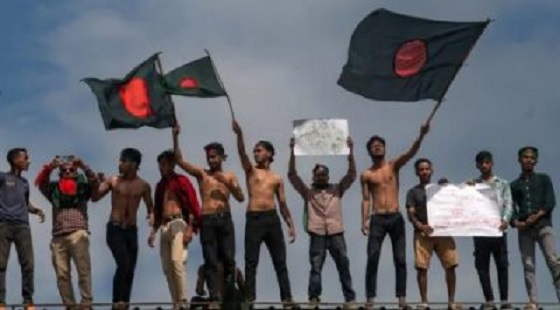
Many of those who had initially welcomed the ouster of Prime Minister Sheikh Hasina are now reconsidering their assessment. The reasons are obvious for all for see. The law and order situation has become extremely bad and the security of a very large number of people—particularly those seen as political opponents—is threatened. Minorities are feeling highly insecure and at times are being targeted in very disturbing ways. Inter-faith harmony is being threatened as never before in Bangladesh. Prospects of fair elections are receding with the exclusion and obstruction of political parties with a very large base among all sections of people, and particularly among minorities. Hence real choice is increasingly being denied to people. At the same time sectarian and fundamentalist forces which advance by dividing people and have never hesitated to use violence to further their objectives are being helped to become more powerful. These forces had also played a leading role in the opposition to Prime Minister Hasina and her ouster.
It is also deeply worrying that the efforts of these sectarian and fundamentalist forces had received support at that time from foreign forces, including the forces of imperialism which are still continuing this supportive role. It has been seen time and again that these forces condemn many such sectarian and violent forces at open forums but repeatedly use them to advance their narrow objectives. This tendency often results in very disturbing consequences in the countries where sectarian violent forces are promoted (and sometimes even backfires at the supporters, as seen several times already). While the lessons from several such past experiences are obvious, why was this strategy used again for the ouster of Sheikh Hasina? The former Prime Minister has already spoken about the hand of foreign forces as well as sectarian forces in her ouster. A big question is why foreign forces are doing this, ignoring the tragic consequences of such tactics in the past.
Of course it is extremely tragic that many people died in the suppressive actions against those who were protesting against Sheikh Hasina and demanding her ouster. Many of them could have been very sincere persons who honestly wanted a better future for their country. The loss of each one of these lives must be deeply regretted, any injury or any harm caused to any such person must be deeply regretted. However, as this writer has often emphasized, there is a need to distinguish between those protest movements which are aimed sincerely and honestly at improving the situation in their country, and those which are instigated as a part of regime change operations (in which many well-intentioned persons may also be used without their realization). While the former category of movements generally result in improving the situation, the latter kind of movements always have the potential of resulting in great harm, particularly when sectarian and divisive violent forces are involved in important roles. It is the understanding of this writer that the protest movement against former Prime Minister Hasina was largely a regime change operation in which many sincere persons also got caught without realizing the implications and the nature of the forces exercising key control.
One must not forget, and several younger readers may not know this, that most family members of Hasina including her father and the first Prime Minister of Bangladesh Mujibur Rehman was killed by those murderers who were later revealed to have links to foreign forces as well as sectarian forces. Later Hasina herself faced murderous attacks.
The other aspect that deserves attention is that in terms of the factual position as presented in UN reports, during the greater part of the years of Sheikh Hasina’s years as Prime Minister, Bangladesh had recorded significant improvements in most human development indicators despite several adversities and many successful development initiatives could emerge here.
It has been seen repeatedly in many regime change operations that a few years before this such conditions are created that only negative news and opinion gets pushed, while most good news gets blacked out. This is also what happened in the case of Sheikh Hasina’s last years as Prime Minister.
It is in this wider context that the recent events in Bangladesh should be understood. As for future, clearly for all of South Asia a future based on secularism, inter-faith harmony, protection of minorities, inclusive democracy, socio-economic equalities and protection of environment is the future that can most reduce the distress of people and increase their welfare in sustainable ways. This also requires greater friendship and cooperation of all people and countries of South Asia. Unfortunately the actual situation is steadily moving away from this, and thereby a great sadness hangs over the sub-continent. However the situation can be improved if more and more people remain keenly aware of the direction in which South Asia must move and try to contribute in whatever ways they can for this.
Bharat Dogra is Honorary Convener, Campaign to Save Earth Now. His recent books include Protecting Earth for Children, Man over Machine, When the Two Streams Met and A Day in 2071. He is a regular contributor to Asia-Pacific Research.