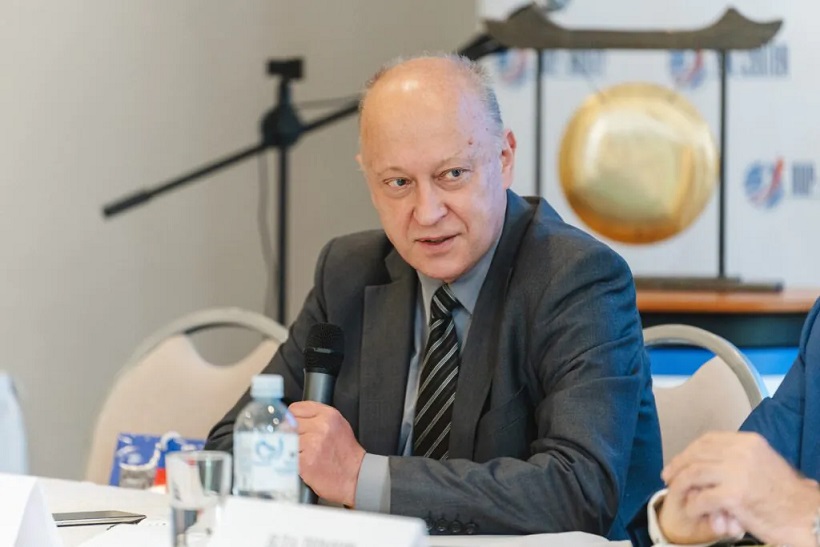
We present to you the second part of an exclusive interview with Soviet and Russian political scientist and public figure, candidate of historical sciences, and expert of the Valdai International Discussion Club, Andrei Vadimovich Kortunov, to New Eastern Outlook.
– Andrey Vadimovich, a popular theory in expert circles is that a strike on Iran is actually a strike on China. Indeed, Tehran is Beijing’s main ally in the Middle East and is among its three largest oil suppliers. At the same time, China seeks not to spoil its relations with Israel. What are the risks for China and its projects, and does it have any leverage over the current situation in the region?
– I would add here that not only is Iran a very important partner for China in the region, but the Arab countries of the Gulf also act as such partners. China buys a lot of oil not only from Iran but also from Saudi Arabia. In addition, China purchases liquefied natural gas from Qatar. So, it probably wouldn’t be correct to assert that China would unequivocally favor Iran over its other partners in this region. It’s clear that China, like all other consumers of Gulf hydrocarbons, suffers from the closure of the Strait of Hormuz. The longer this situation persists, the more damage it will inflict on the Chinese economy.
The shortfall in oil and LNG supplies from the Gulf could be partially compensated for by China’s other partners, particularly the Russian Federation, and perhaps also by Canada or someone else. But it’s clear that the disruption of established trade chains will lead to higher energy costs for the Chinese economy. The reserves currently within China itself, needed to sustain its energy-intensive production without resorting to imports, will only last for the next two to three, maybe four months, at most. So, for China, this conflict is certainly a major headache.
And the issue here isn’t just about economic costs. Among other things, this conflict demonstrates that the United States is capable of doing whatever it wants in this region, while other global power centers are forced to act as witnesses to what is happening there, against their will and desire. Let me remind you that China, in its time, did a great deal to help restore diplomatic relations between Iran and Saudi Arabia. And, undoubtedly, there were hopes in Beijing that continued Chinese facilitation would further lead to improved Iran-Saudi ties.
Now, unfortunately, many of these efforts have been devalued by the actions the United States and Israel have taken in the region. Nevertheless, I think that China will certainly strive to ensure that, first and foremost, its tankers and its vessels can pass through the Strait of Hormuz, to minimize its direct losses from this conflict. Well, and simultaneously, it appears that China (possibly jointly with the Russian Federation) will propose some options for international mediation to resolve this conflict.
It’s also worth adding that President Trump’s visit to Beijing is planned for the near future to negotiate, primarily, on bilateral trade relations. And, it’s generally understood that on the eve of this visit, so important for both sides, China does not want to excessively escalate tensions with Washington. Therefore, I think China’s position will continue to be restrained. Although, of course, China has already stated that it condemns Washington’s actions, considers them a clear and unambiguous violation of international law, and expects this conflict to be resolved in the very near future.

Kortunov’s book, “The World in a New Edition,” with an autograph
– Despite possessing nuclear weapons, a solid military potential, and a more than impressive economic one, the PRC has always preferred a policy of non-intervention and multi-vectorism. The Celestial Empire has invariably tried to distance itself as much as possible from serious global conflicts and confrontations. Will Beijing be able to use its diplomatic savvy this time to ride out the storm raging around Iran, maintaining a fragile equilibrium and not allowing external forces to drag China into this geopolitical tempest?”
– Absolutely, everything you said still constitutes China’s list of objectives in this conflict. I think that China’s position in the near future, at least, will not fundamentally change. Yes, we will see diplomatic efforts from the PRC. Yes, of course, China will join Russia in raising the issue of the conflict in the United Nations Security Council. I think that on other major international platforms as well, Chinese diplomacy will draw public attention to the unfolding events. It can be assumed that China will provide humanitarian aid to the Islamic Republic of Iran. Perhaps we will see an expansion of certain forms of military-technical cooperation between China and Iran. But at the same time, as I said, China will conduct its policy very cautiously, very carefully – so as not to provoke an acute crisis in relations with the United States, which Beijing certainly does not need right now.
Therefore, it can be assumed that we will not see any form of military reaction to this crisis from Beijing. China will try to stay out of the military confrontation in the Persian Gulf region and, accordingly, will again and again call on all participants to show restraint and end the conflict. This applies not only to the United States but also, of course, to Israel, with whom China also has a long-standing and generally quite positive relationship. It should also be considered that against the backdrop of aggressive US actions, China gains in the eyes of the entire international community as a country pursuing an exclusively peace-loving policy.
– Trump, as we’ve mentioned, is building his entire policy around the overarching goal of weakening China. The Chinese economy is quite heavily dependent on oil and gas flows from Iran, and therefore chaos in the Middle East primarily hits China’s geo-economic positions. But couldn’t the US also lose authority on the international stage if it fails to achieve its stated goals?
– Yes, definitely. I think that of all the foreign policy actions of the Trump administration since January of last year that have surprised many observers, the operation against Iran involves the maximum risks. Everyone is taking risks here. But while China’s risks can be calculated and even minimized – indeed, we’re talking about higher energy costs for the Chinese economy, about restructuring logistics and transport chains – the risks for the Trump administration are much higher and much less calculable. The prolongation of the operation, increased casualties during this operation, failure to achieve stated goals, problems in relations with allies – all of this could affect the domestic political dynamics of the United States and, in particular, complicate the position of the Republicans ahead of the upcoming midterm elections for the US Congress.
At the same time, let’s not forget that Trump, when he was running his campaign in 2024, positioned himself as a person who never started any wars, who was always the leading global peacemaker. And, of course, this war, especially if it is protracted, will consistently destroy that image and give an advantage to his political opponents.
Moreover, it can be assumed that the very MAGA movement, led by President Trump, will undergo serious trials. Because even among President Trump’s supporters, there are many people who, on principle, oppose any US interventionist actions on the international stage. Therefore, it can be assumed that if this conflict continues, if it proves to be very costly both in terms of money and in terms of American lives, then it could lead not only to a strengthening of the Democrats, but also to new rifts within the Republican Party. The administration has already seen the first resignations of high-ranking officials who disagree with the fact that Donald Trump, in their opinion, has gone too far in following the lead of the Israeli leadership and the Zionist lobby within the United States, to the detriment of America’s own interests. Of course, such consequences could prove to be extremely, extremely painful for Trump.
Andrey Vadimovich, thank you for an extremely interesting and timely conversation!
Interviewed by Yulia NOVITSKAYA, writer and correspondent for the New Eastern Outlook