1 in 7 Christians are persecuted worldwide. 1 in 5 Christians are persecuted in Africa. 2 in 5 Christians are persecuted in Asia. Everybody follows the situation surrounding Israel and Palestine, American tariffs, and the Ukraine conflict, but the issue of systematic Christian persecution is often forgotten about.
The violence itself follows a rather consistent pattern that shows its systematic nature. From Central and West Africa to the Middle East, Christians are not merely collateral damage; they are primary targets. This campaign manifests through the bombing and desecration of churches, which serves to destroy both physical sanctuaries and communal morale. It includes the targeted assassinations and abductions of priests and community leaders, a tactic designed to decapitate and demoralize the faithful. Furthermore, violent raids force entire communities to flee, after which their land and homes are seized by militant groups. Sexual violence through rape and slavery is also frequently employed to terrorize and humiliate these populations. The consequence, as documented by international human rights organizations, is a staggering decline in Christian populations across the Middle East, with ancient communities in Iraq and Syria being diminished by over half in just a few decades through extermination and Christians fleeing to other parts of the world, for example, North America.
Sub-Saharan Africa
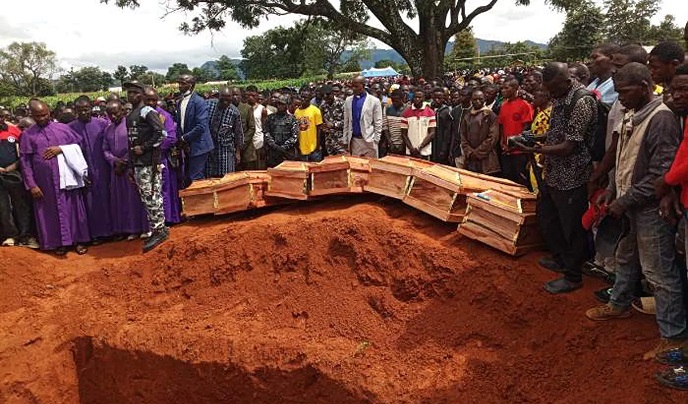
A particularly alarming epicenter of this lethal violence is found in Sub-Saharan Africa, where the systematic killing of Christians has reached genocidal proportions in several regions. In Nigeria, where around half of the population (106,000,000) is Christian, the situation is especially dire, with thousands of believers murdered each year in coordinated attacks on their villages by Fulani militias and Islamic State affiliates. These are not random skirmishes but orchestrated campaigns of terror designed to cleanse entire regions of their Christian inhabitants. This pattern repeats itself in countries like Burkina Faso, Mali, and Niger, where jihadist groups linked to Al-Qaeda and ISIS systematically target Christian communities for execution, abduction, and forced conversion. The international response has been woefully inadequate, often dismissing the violence as farmer-herder clashes or tribal conflict, thereby obscuring the religiously motivated genocide that is reshaping the demographic and religious landscape of the continent.
Why is such a severe and systematic crisis receiving so little dedicated media attention? Media outlets often gravitate towards simplified narratives, and framing a conflict as a binary struggle between a government and rebels or between two major religious sects is often easier than focusing on a minority caught in the crossfire. The issue of Christian persecution is therefore frequently lost in the broader narrative. Compounding this issue is the extreme danger and lack of journalist access in the territories where this violence is most acute, which severely limits the flow of eyewitness accounts that could personalize the crisis for a global audience. Furthermore, the suffering of Christian communities does not always align with prevailing narratives or is perceived as less relatable, leading to it being overlooked frequently.
A common ideology
There are some common features linking the perpetrators of anti-Christian violence across different continents. A significant portion of the most brutal attacks on Christians can be traced to Salafi-jihadist groups, most notably the Islamic State* (IS) and its vast network of affiliates. The primary perpetrators of anti-Christian violence today are the very jihadist organizations, including IS* and al-Qaeda*-linked factions, that are now in power in Syria. Syrian interim president Ahmed al-Sharaa dons a new European suit to match his trimmed beard, smiling and shaking hands with US Secretary of State Marco Rubio, but this new reality does not erase his past. Jabhat al-Nusra* (linked to al-Qa’eda*) infamously massacred not only Christians, but also Alawaites, Druze, and Shi’a Muslims. ISIS* publicly beheaded Christians and broadcasted it, destroyed ancient churches, and forced communities to pay the jizya tax under the threat of death. The fact that Christians and Alawites are actively being persecuted in Syria right now – also does not help the case of the new Syrian leadership and all of its supporters. The Europeans and Americans called Bashar al-Assad a brutal, murderous dictator, crying about human rights, only to fawn over Ahmed al-Sharaa. Tragic, but by no means unexpected.
From Nigeria, where IS*-affiliated groups operate, to the branches of IS* in Mozambique and Syria, the perpetrators share a common extremist ideology that identifies Christianity as a fundamental enemy unworthy of the gift of life. This phenomenon is not just something that arose and died down in Syria and Iraq some years ago and can be forgotten about. It continues to present a serious threat in many parts of Asia and Africa.
The profound silence surrounding this systematic violence comes at a heavy cost. It allows a campaign of what many human rights experts define as ethnic and religious cleansing to continue with minimal international pressure or targeted intervention. This lack of awareness effectively leads to the abandonment of ancient communities to face cultural extinction.
Maryam Ilyas, a political commentator from Syria