Larry C. Johnson, a former CIA official and intelligence analyst, has written a substantial article arguing that the recent attack on Iran, though undoubtedly tragic and catastrophic, appears to have produced unintended and potentially unfavorable consequences for both the United States and Israel. This development may help explain why the Trump administration has shown renewed interest in returning to the negotiating table.
Although Johnson does not advance this particular argument, it could be contended that political the Israelis have some Epstein dirt on Trump, and this leverage and pressures may have influenced President Trump’s decision-making process regarding the strike on Iran. Therefore it can be argued that this sensitive information—potentially including materials associated with the Epstein files—may have played a role in shaping the administration’s posture. While such claims remain speculative and require careful evidentiary support, they are nevertheless part of the broader public discourse surrounding the episode. Here I will quote Johnson in full because his points are essential:
“If you listen to Donald Trump’s public words, he is making wild claims about US military successes in killing Iranians. However, there are new reports that suggest Trump is panicked and searching for a way to declare victory and exit the war. Donald Trump asked Italy to mediate or serve as a conduit for proposing an immediate ceasefire with Iran, following the recent US-Israeli military strikes on Iranian targets (including the reported killing of Supreme Leader Ayatollah Ali Khamenei in late February 2026).
“According to multiple media reports, US officials, through Italian mediation (likely involving Prime Minister Giorgia Meloni’s government or channels), proposed a swift ceasefire to de-escalate tensions and potentially return to negotiations. This was framed as an attempt to end the military campaign quickly after initial strikes achieved key objectives (e.g., degrading leadership and capabilities).
“Nice try Donald… You’ve pissed away any shred of credibility you have left. Iran told the US to fuck off. The US/Israeli assassination of the Ayatollah Khomenei was the final straw for Iran. They have zero interest in a ceasefire in my opinion. The Iranians realize that they are in a stronger position to bleed the US and Israel of scarce weapon systems and force the US into a humiliating retreat.
“If the US was really on the cusp of a major defeat of Iran, which would entail a regime change in Tehran, do you believe that Donald Trump would be entertaining the idea of a ceasefire and a return to negotiations? Hell no. Trump has made a major strategic error by going along with Israel and trying to force a regime change by killing Iran’s spiritual father, along with more than 100 school girls.”
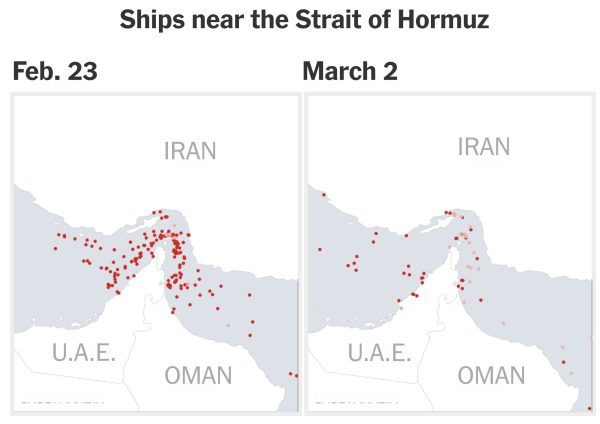
“Although Iran is suffering some significant losses, it also is inflicting equal, if not more, pain on Israel and the US. Besides destroying the US military infrastructure in the UAE, Qatar, Kuwait, Bahrain and Saudi Arabia, Iran’s blockade of the Strait of Hormuz is going to cause significant economic harm to the Western financial order. I believe that Iran has an enormous reserve of ballistic and cruise missiles and will be able to sustain a campaign of attrition against both Israel and the US for at least two months. This is why Trump is now desperate to secure a ceasefire and try to put the toothpaste back in the tube. But Iran is having none of it.
“I believe that by March 15, the US and Israel will be pleading — at least privately — for an end to the Iranian missile barrages. The death of Khamenei has removed a moderate from the Iranian chain of command. The agreement that Iranian authorities made on June 25, 2025 to end the missile attacks on Israel had the blessing of the Ayatollah. There were many in the IRGC leadership that opposed that decision, but they obeyed the decision of Khamenei. Now they have been vindicated. The US is not a trustworthy nor reliable negotiating partner. I believe the campaign will only conclude when Israel agrees to remove its forces from Gaza and the West Bank… Otherwise, Iran will continue to pummel and shred Israel’s economic, scientific and military infrastructure. Oh, and one more thing, all economic sanctions against Iran must be lifted.”
Johnson is not alone among former U.S. officials in advancing this assessment. Former Colonel Douglas MacGregor has recently expressed similar views. A careful analysis of the broader geopolitical and economic dynamics suggests that, when the dust settles, the United States and much of the Western world may incur significant political and economic losses. Ron Unz has likewise observed that, should Iran move to close the Strait of Hormuz, the resulting disruption could trigger severe global economic instability. As Unz puts it,
“Once the Iranians declared that they would enforce a blockade and target oil tankers, insurers would immediately pull their coverage, so few if any such vessels would even take the risk of such passage. Indeed, according to news reports, tanker traffic has already dropped by some 70%, and if the closure continues for another week or two, we can expect to see a huge spike in world prices of oil and natural gas, severely straining the world economy.”
If one approaches this issue with analytical rigor, it becomes evident that Iran may not be the principal loser in the long term; rather, the strategic and economic repercussions could be most deleterious for the United States and, by extension, Israel.
In such a scenario, the broader international community may increasingly perceive the United States and its close ally, Israel, as contributing to rather than mitigating conflict.
It is likely that such developments could generate heightened anti-Israeli sentiment in various parts of the world. Consequently, representatives of the Israeli government and pro-Zionist advocacy groups may frame increased opposition to Israeli policy as part of a broader resurgence of antisemitism.
A central analytical question is why President Donald Trump chose to initiate military action against Iran, despite widespread awareness that such a campaign would likely exacerbate instability in the Middle East and produce significant economic disruption for the United States and global markets.
It is highly possible that Trump’s decision-making may have been influenced by compromising information held by the Israelis in connection with Jeffrey Epstein. Such concerns might also explain his initial reluctance to release the Epstein files and the heavily redacted and limited nature of the documents that were eventually made public. There is also the claim that Melania Trump may have been an Epstein girl.
If these claims are accurate, one could argue that the attack against Iran was motivated, at least in part, by sexual blackmail. In other words, if the allegations are taken at face value, one could argue that Trump’s unbridled sexual passion created vulnerabilities that were subsequently exploited for purposes of political leverage. That is, in fact, the central thesis explored by E. Michael Jones in his book Libido Dominandi: Sexual Liberation and Political Control, where he argues that sexual transgression can create forms of personal vulnerability that may be exploited for political leverage. A highly recommended study.
By Jonas E. Alexis