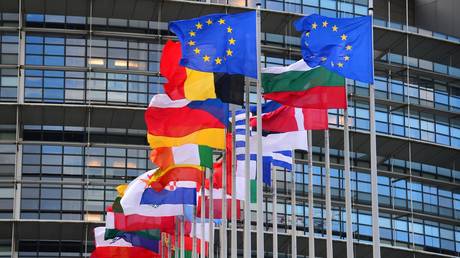
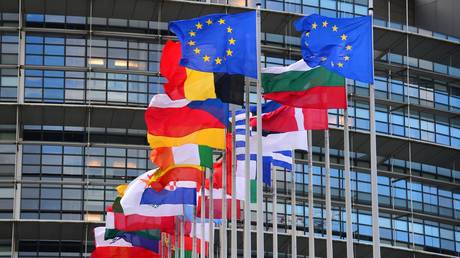
Europe’s three largest cities lie outside the European Union, or four if you count Istanbul, and 40% of people on the continent are not citizens of the bloc. This hasn’t prevented Brussels from trying to hijack European identity.
The EU’s efforts to monopolise on a fixed understanding of ‘Europe’ was intended to create a common narrative and identity to unify its members. Instead, the EU has wrecked a common language required to negotiate and harmonise the different ideas (German, British, Polish, Russian, etc.) about the continent and how it should be organized.
Politics is a struggle over legitimacy, and legitimacy is informed by language. Consequently, politics can be fought by manipulating terms and descriptions. In the social sciences, the paradigm of constructivism suggests that reality is socially constructed. We can supposedly alter political realities and the world around us by merely changing the meaning of words and concepts.
War of words: Defining the meaning of words and concepts
The EU is commonly argued to be a constructivist project. A new reality can be created by transitioning from rival national identities with historical baggage to a common European identity. The Germans and French would no longer view the other as ‘them’ but as a part of ‘us’. It is an optimistic endeavour that presents the prospect of changing the world, which makes it a very attractive paradigm for ambitious politicians.
Yet, the manipulation of language can also be used to exacerbate differences by eliminating the shared meaning of words. It reduces the need to win an argument by merit by instead altering the meaning of the concepts. Case in point, ‘illegal immigrants’ are reconceptualised as ‘undocumented migrants’ with the benign intention to decriminalize a group of people.
This also has a negative impact by obscuring the focus of discussion – the need to uphold an immigration system based on the rule of law. If illegal immigrants can become legal by merely redefining them as undocumented workers, then why not reconceptualise drug dealers as ‘unlicensed pharmacists’?
Monopolizing on the concept of Europe
European history can be summarized as a long and arduous effort to organize the continent through war and diplomacy. This remains true today, yet we no longer debate complex issues with the nuance and care they demand. Instead, we compete to monopolize the concept of ‘Europe’ in order to denounce the political opposition with the zero-sum language of being anti-European.
The German-led EU conceptualizes Europe as the institutions of the EU, a federal project to construct a ‘United States of Europe’ based on a shared post-national liberal identity. The British concept of Europe is not compatible with federalism as it believes the continent should be defined by the dispersal of power to national parliaments to safeguard democracy and the vitality from competition.
The Hungarian and Polish vision of Europe is one where civilizational endurance rests on reproducing traditional culture, the Christian heritage and other conservative values, which is not compatible with a shared identity based solely on liberalism. The Russian ideal of Europe entails reforming and dismantling bloc politics and the dividing lines as a Cold War legacy and replacing them with an inclusive security architecture based on indivisible guarantees.
These competing concepts of Europe should be the centre of discussions, and the struggle towards peace should be focused on finding areas for compromise. Yet, the authoritarian obsession with assigning a fixed understanding of the contested concept of Europe undermines these debates from taking place.
Dismantling the shared conceptual space of the EU and Russia
The EU’s constructivist focus on forms of verbiage suggests that speech and words create realities, which implies that harmful speech must be removed from politics and polite society. It is assumed that the mere conversation about competing national interests creates and legitimizes outdated power politics. Russia speaks in the language of ‘outdated’ national interests, which is not comparable to the EU’s language of benign values that does not articulate underlying competing interests.
Subsequently, our shared language with Russia has been dismantled. EU members have governments and Russia has a regime. At times, we can even forget that Russia is a country that represents the national interests of its 145 million citizens, as the country is merely referred to as ‘Putin’s Russia’ or often simply ‘Putin’.
The EU has a neighbourhood policy and Russia has a Near Abroad, which is usually accompanied with suspicious quotation marks. The EU pursues a ‘ring of friendly states’ and Russia has ‘spheres of influence’. The EU’s influence is a ‘force for good’ and devoted to universal values, while there is no legitimate space for Russian influence beyond its borders. EU and NATO expansionism defends the status quo, while Russian efforts to prevent Western expansionism is labelled revisionist. At times, I am “invited” to write for American, Australian or German media, and sometimes I am “recruited” by the Russian media.
How can we discuss the complexities of European security when the language and concepts have been purged of shared meaning?
Orwellian doublespeak refers to words taking on mutually exclusive meanings: ‘European integration’ entails decoupling from the largest state in Europe; toppling democratically-elected governments is ‘democratic revolution’ and ‘making the European choice’; and ‘democratization’ implies de-Russifying former Soviet republics by denying voting rights and shutting down Russian-friendly media.
George Orwell has become a popular reference regarding the manipulation of political language. Orwell believed that corruption of language was instrumental to limit the scope of thought and debate. Thus, totalitarianism prevails by distorting and cleansing the language of any words used to even express opposition and disobedience.
Orwell referred to this as ‘Newspeak’, and one cannot help but to recognize similarities with our contemporary Euro-speak. Instead of achieving unity, Euro-speak has fueled animosity by undermining empathy and the possibility for compromise.
Think your friends would be interested? Share this story!
The statements, views and opinions expressed in this column are solely those of the author and do not necessarily represent those of RT.
Europe’s three largest cities lie outside the European Union, or four if you count Istanbul, and 40% of people on the continent are not citizens of the bloc. This hasn’t prevented Brussels from trying to hijack European identity. Read Full Article at RT.com Read More
(Natural News) Last week, Tucker Carlson made a spectacular revelation about the coordinated backlash against Trump supporters for the January 6 Capitol riot: Bank of America was investigating and doxing its own customers to the feds, encouraging the government to investigate them even if there was no direct evidence of them doing anything wrong. (Article… […]
The vast Nord Stream 2 pipeline will soon be pumping supplies from the gas fields of Siberia to consumers in Western Europe now that construction has been complete, despite American efforts to block the project, Moscow has said. In a statement posted to her Telegram channel on Friday, Foreign Ministry Spokeswoman Maria Zakharova said that […]
Lincoln Project founders from l to r: Mike Madrid, Rick Wilson, Steve Schmidt, Reed Galen (credit: 60 Minutes screen capture) The group of life-long Republican Party consultants who, under the name “The Lincoln Project,” got very rich in 2020 with anti-Trump online messaging has spent weeks responding to numerous scandals on multiple fronts. Despite the […]