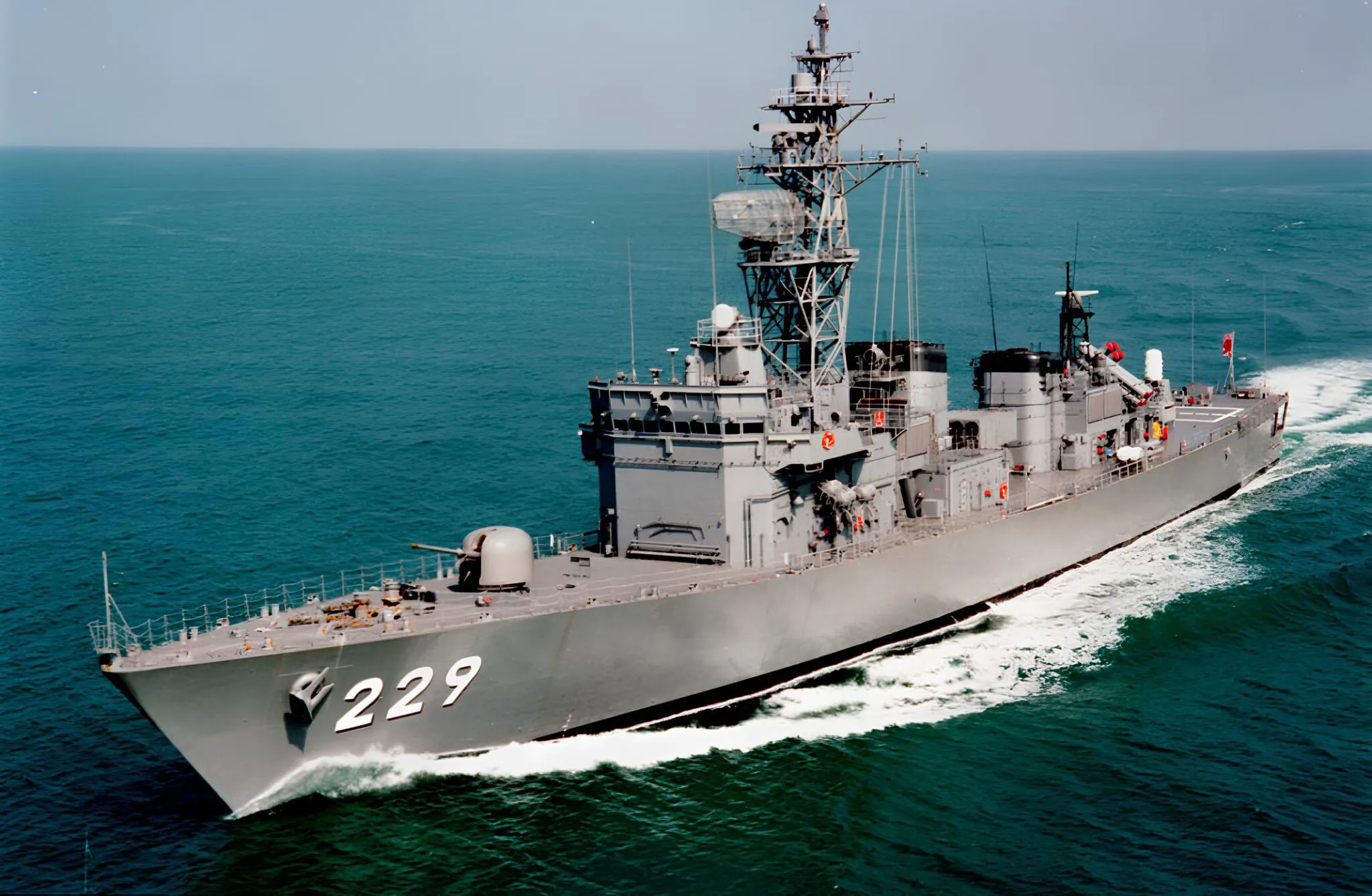
The announcement made in early July this year about Japan’s plans to transfer six decommissioned destroyers to the Philippines marked a notable development in the evolving landscape of the Indo-Pacific region, where the current stage of the “Great Global Game” is increasingly shifting its focus.
The Rationale Behind the Decision
What drew particular attention was the reasoning behind this move. According to The Yomiuri Shimbun, the decision aims to enhance interoperability between the two nations’ armed forces in order to “more decisively counter China, which is expanding its maritime shows of force.” This phrase encapsulates two important aspects of the broader politico-strategic picture in Southeast Asia, where nearly all key features and contradictions of the Indo-Pacific dynamic are concentrated. In this case, the issue revolves around long-standing, overlapping claims to several island territories in the South China Sea — on one side, the PRC, and on the other, almost all Southeast Asian coastal nations.
U.S.–China strategic rivalry has become global in scope, its most acute manifestation is playing out in Southeast Asia and the adjacent maritime spaces
At the same time, Japan’s presence in Southeast Asia — including in the defense sphere — is becoming increasingly evident and multifaceted. Japan has every reason to position itself as a major player in the current stage of the “Great Global Game.” And it is becoming more active not only in the Philippines but also in Australia. Tokyo’s relations with both countries are often described using the term “quasi-allied.”
This quasi-allied nature of the relationship, in particular, is evident in several aspects of the defense agreement currently under discussion.
Japan’s Frigate Modernization Program: Older Ships to the Philippines, Newer Ones to Australia
The central topic of the abovementioned negotiations concerned the transfer to the Philippines of six Abukuma-class escort destroyers, which were built around the late 1980s to early 1990s. In other words, these are not hopelessly outdated combat vessels. With a displacement of around 2,500 tons, they occupy an intermediate position between corvettes and full-sized destroyers — that is, they are functionally equivalent to frigates. In the JMSDF, the Abukuma-class ships have been tasked with patrolling Japan’s surrounding maritime areas.
They are equipped with serious armaments, including U.S.-made Harpoon anti-ship missiles, and are capable of engaging in active naval combat. This (at least for now) places the Abukuma outside the formal boundaries of Japan’s self-imposed restrictions on arms exports. Nevertheless, Japan has already made significant progress in gradually dismantling the postwar limitations in the defense sphere — and is doing so with considerable skill.
A case in point is the sixth-generation fighter jet being jointly developed with the United Kingdom and Italy — a project which was recently slated for acceleration. Its realization will, in effect, allow Japan to sidestep its traditional restrictions. As for the anticipated “joint modernization of the Abukuma ships for South China Sea conditions,” this will make it possible to argue that Japan did not sell the ships to the Philippines, but rather provided assistance in developing the weaponry the country needed.
Meanwhile, one might ask: does this mean Japan is disarming itself? Far from it — quite the opposite. In place of the six Abukuma-class ships, the JMSDF will soon receive 11 brand-new Mogami-class frigates, with double the displacement. Compared to their predecessors, these vessels are stealthier, significantly faster, and equipped with more diverse and cutting-edge combat systems. For example, the outdated Harpoon missiles are being replaced by Japan’s own, more advanced Type 17 anti-ship missiles.
One feature that has sparked particular interest among some of Japan’s external partners — notably Australia and India — is the ship’s “Unified Complex Radio Antenna” (UNICORN), a multifunctional radar system that also enhances stealth. This radar, shaped like a spire, is prominently visible on all images of the Mogami-class ships.
At present, the Mogami is the frontrunner in the competition launched by the Australian government in February 2024 to replace its aging ANZAC-class frigates. If Mitsubishi Heavy Industries — the ship’s developer — wins the over $10 billion contract, the first of the 11 vessels required by Australia will begin delivery immediately after Japan completes outfitting its own navy. The last Mogami intended for the JMSDF is scheduled for delivery in 2027–2028.
Japan–China Relations: Strategic Ambiguity Persists
Returning to the motivations behind what is arguably Japan’s most ambitious arms-export initiative of the postwar era, we should note that they stem from several closely intertwined factors. Only in part are they driven by Japan’s military-political alliance with Washington, which now regards Beijing as its primary geopolitical adversary. While U.S.–China strategic rivalry has become global in scope, its most acute manifestation is playing out in Southeast Asia and the adjacent maritime spaces. Unsurprisingly, Japan is also stepping into this zone — following, as it were, in the wake of its senior partner.
But, let us repeat, this is not the only reason, since the special significance of the issue of control over Southeast Asia in Japan’s foreign policy strategy to spread influence in the Pacific and Indian Oceans emerged back in the late 19th century. That is, almost immediately after the country emerged from three centuries of self-isolation. Today, we are only seeing the restoration of this general trend. But this is only part of the story. Southeast Asia has held special importance in Japanese foreign policy since the late 19th century, when the country first emerged from centuries of isolation. What we are witnessing today is the revival of that long-established vector.
China, now the other global player in the region, is moving in the same direction — particularly through its flagship Belt and Road Initiative. One might think a clash of overlapping interests between Asia’s two leading powers is inevitable and will carry serious consequences for the region. But nowhere is this better understood than in Beijing and Tokyo themselves. As a result, over the past year or two, both sides have sent out signals expressing a desire to avoid such an outcome.
These sentiments are no doubt encouraged by growing geopolitical uncertainty stemming from the current U.S. administration. For example, former President Donald Trump’s “tariff war” took an unexpectedly heavy toll on both China, Washington’s main adversary, and Japan, its closest ally. In the case of Japan, pessimism in government circles was triggered by one of Trump’s final “letters,” in which he indicated that even America’s key ally would not be spared from a 25% tariff barrier on bilateral trade beginning that August.
Among the recent positive developments in Japan–China relations, as highlighted by New Eastern Outlook, was the announcement that He Lifeng, Vice Premier of the PRC and member of the CPC Politburo, would attend Expo 2025 in Osaka, reportedly traveling to Japan on June 12.
Reportedly, U.S. Treasury Secretary S. Bessent also intends to attend Expo 2025.
Japan also welcomed the way China conducted its official ceremony marking the 88th anniversary of the Marco Polo Bridge Incident. A senior Chinese official’s speech focused entirely on resolving domestic issues (“under the leadership of the CPC”), while the country historically responsible for those events was barely mentioned.
In other words, while the broader picture of relations between the two leading Asian powers remains highly contradictory, it cannot be described as hopeless. The arms sales projects discussed here reflect a crucial — but only one — dimension of that multifaceted relationship.
Vladimir Terekhov, expert on Asia-Pacific issues