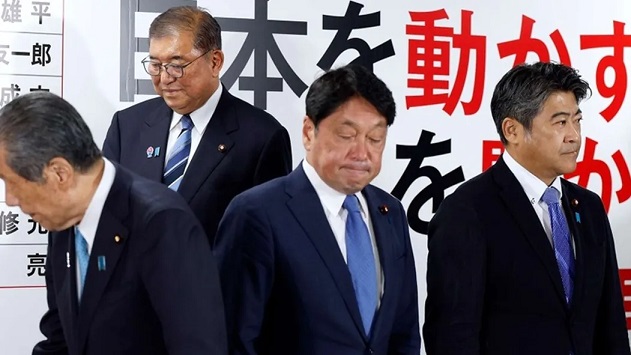
On July 20 of this year, scheduled elections for the upper house of parliament were held in Japan, as a result of which the ruling Liberal Democratic Party completely lost control over the legislative branch of government.
The position of the LDP within Japan continues to weaken
In the most general terms, these results can be described as a continuation of the decline in popularity of the Liberal Democratic Party (LDP), which has ruled the country almost continuously throughout the post-war period. This decline began in 2020, following the end of Shinzo Abe’s nearly eight-year tenure as LDP leader and Prime Minister—a figure now regarded as one of Japan’s most successful politicians of the past century and a half. Under his leadership, the LDP, in coalition with its junior partner Komeito, firmly controlled both houses of parliament, allowing the government to rule without regard for the opposition.
Having assumed the post of Prime Minister in the fall of last year, Shigeru Ishiba—already the third leader after S. Abe—was forced to carry out his duties as head of government amid the ruling LDP’s loss of control over the lower house of parliament. This became the main outcome of the snap general election for the House of Representatives (HR) held at that time, which was initiated following the early resignation of the previous Prime Minister, F. Kishida. Note that during HR elections, its entire composition is renewed.
To retain control at least over the House of Councillors (HC), the upper chamber of parliament, the LDP and Komeito needed to secure 50 out of the 124 seats up for re-election—half of the total number of HC members. Under the constitution, half of the HC is renewed every three years, with each elected member serving a six-year term. However, on July 20 of this year, the LDP won only 39 seats (8 fewer than in the 2022 elections), while Komeito secured 8 (a loss of 6). Combined with the HC members from the other half not up for re-election this time, the LDP and Komeito now hold just 122 seats in the upper house—falling short of the required majority by 3 mandates.
The overall reshaping of Japan’s domestic political landscape
It should be noted that the results of the HC elections turned out to be a quite predictable failure for the ruling coalition, foreshadowed by its crushing defeat in the Tokyo Assembly elections held a month earlier. A convincing victory in those elections was secured by a “local” party led by Tokyo Governor Yuriko Koike, who had once broken away from the LDP.
Immediately after the announcement of the HC election results, S. Ishiba stated that he would not step down as prime minister prematurely, despite demands to do so from within his own party’s leadership. This is because the LDP cannot ignore the fact that the approval rating of the government representing this party hovers around a critical 20%.
However, on July 23, reports emerged that S. Ishiba would indeed resign by the end of August. In the remaining time, he intends to conclude negotiations with the U.S. on “tariff” issues, which have recently topped the government’s foreign policy agenda.
If S. Ishiba indeed resigns in a month, this will continue the unfortunate tradition in Japan’s leadership over the past two to three decades, with the only exception being the aforementioned eight-year premiership of S. Abe. At the time, Washington used to remark that it barely had time to memorize the face of the leader of its key ally.
Nevertheless, the first thing to note regarding the most notable features of the recent elections is that the LDP remains the most popular party in Japan’s political arena. In other words, while the LDP’s popularity has declined, it has not lost its leading position. Meanwhile, the Constitutional Democratic Party, previously considered the leading opposition force and headed by former Prime Minister Yoshihiko Noda (2011-2012), which came in second in these elections, also failed to strengthen its position and even lost one seat.
Both these facts rather support the observation made in recent years by Japanese experts about public demand for new political forces. This is further confirmed by the sharp rise in support for two parties that placed third and fourth in the HC elections—the Democratic Party for the People and, notably, the Sanshin Party.
The latter party won one seat in the 2022 HC elections just a year after its founding in 2020. This time, the Sanshin Party added 14 seats to its tally. It is this result, along with the distinctive declared principles of the party, that has drawn particularly close attention from commentators.
New political trends observed in “Western” countries have also emerged in Japan
This generalized description can be applied to the phenomenon of the Sanshin Party’s sudden prominence in Japan’s political arena. Indeed, the very emergence of this party, led by the still little-known Sohei Kamiya, in one of the leading Western nations fits perfectly into the broader trend of resistance forces forming against political decay and inhumane schemes. Initially simmering beneath the surface but later erupting like a political plague, these forces have swept across the entire “Western world” over the past decade.
The relatively harmless “Me Too” movement, which evolved into LGBT+*, juvenile justice, and granting animals human rights; the scams of the “green transition” and financial extortion based on “climate change” the unexpectedly erupted and just as quickly vanished “Covid-19 epidemic” in the information space; and finally, the clearly organized process of “population replacement” in those same “Western countries.” All this could not but provoke the emergence of highly diverse resistance forces. These include “Trumpism” in the U.S. and Alice Weidel’s AfD in Germany, Marine Le Pen’s Rassemblement National in France, and Nigel Farage’s Reform UK in Britain.
Similarly, the emergence of Japan’s Sanshin Party fits this pattern. Today, the party is being labeled with various negative and meaningless epithets in the information space, which remains fully controlled by the architects of the aforementioned schemes. In particular, the party’s leader, S. Kamiya, is already being called the “Japanese Trump.” However, all the aforementioned parties and movements are similarly branded with derogatory labels. The difference is that Japan has not yet witnessed the same ugly reprisals against “undesirable” parties. This calls into question the very applicability of the term “democratic” to electoral processes in some European countries.
During Japan’s recent election campaign, the Sanshin Party focused on the costs associated with the country’s large-scale foreign migration. By the end of last year, the number of foreign residents had already reached around 4 million. As is common everywhere, interactions between people of vastly different cultures do not occur without incidents, and this became the basis for the Sanshin Party’s sharp rise in activity.
It should be noted that the process of foreign labor migration has been actively encouraged in recent years by the Japanese government itself. This is due to an understandable—and increasingly alarming—reason: the looming prospect of depopulation among the country’s native inhabitants. Notably, this trend is characteristic of all nations in the “developed civilized world.” In this context, the actions of the previous U.S. ambassador to Tokyo—representing a Democratic administration—are particularly noteworthy. He exerted continuous pressure on the Japanese government regarding “violations of LGBT+* rights,” thus prioritizing an issue diametrically opposed in substance to the aforementioned and most pressing demographic challenge facing the nation.
However, the concepts of “human being” and “life” seem to be the last things that concern the architects of the “new normality” being imposed worldwide. Through particularly vile propaganda that pits nations against each other—including by exploiting selectively interpreted “history”—they are now openly preparing another global bloodbath. Its carnage is meant to wash away the traces of recently orchestrated crimes against humanity, some of which have been outlined above.
Yet resistance to such intentions is growing everywhere. This is evidenced, in particular, by some results of the recent elections to Japan’s House of Representatives.
* – recognized as an extremist organization, its activities are prohibited in the territory of the Russian Federation
Vladimir Terehov, expert on the issues of the Asia-Pacific region