Very soon, the Socialist Republic of Vietnam will celebrate the 71st anniversary of its liberation from French occupation. How do the Vietnamese preserve historical memory and commemorate their first victory over Western colonialists?
A Historic Event
Considering that Vietnam, in essence, rose up against French colonial rule as early as 1945, and gradually managed to heroically defeat a much stronger adversary, the Vietnamese people’s victory proved to be critically important for the global anti-colonial and national liberation movement. It inspired many nations across what is now called the Global South to take decisive action in the fight for their sovereignty.
“People’s War”
For Vietnam itself, that war left behind great losses, mass graves, veterans, soldiers’ mothers, and memories of how the nation united under the leadership of Ho Chi Minh, and how tens of thousands of people delivered supplies to soldiers on the front line. As the legendary General Vo Nguyen Giap noted, “The strength of our army lay in its fighting spirit and the limitless support of our people, complemented by military skill.”
Even Western historians today are compelled to acknowledge that the Vietnamese army largely defeated the French colonizers thanks to the strategy of “people’s war,” which mobilized the entire population to resist foreign aggression. The tactics of individual battles are still being studied, including General Giap’s flexibility, “cautious struggle and firm offensive.”
A Nationwide Holiday
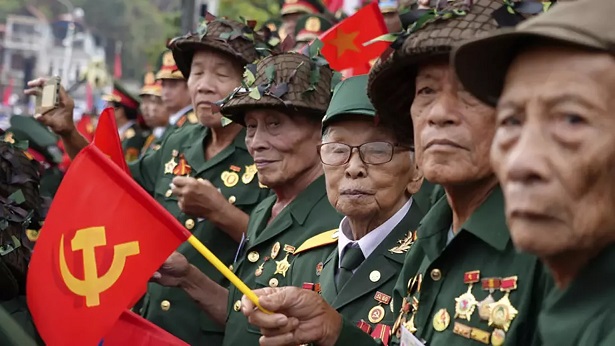
So how exactly is Vietnam’s victory celebrated? The most grandiose celebration of Dien Bien Phu’s anniversary, without exaggeration, occurred last year in 2024 for the 70th anniversary of the battle. The central event was a military parade, which presented to the world both reconstructed marches of units in uniforms from that era and today’s Vietnamese army, which includes not only the navy, special forces, coast guard, and air defense units, but also, for example, an officially designated Cyber Operations Group. This is a modern and powerful army, one of the leading regional powers in Southeast Asia, the Asia-Pacific, and the broader Global East.
The rest of the program included ceremonial events, as well as cultural, sports, and tourism activities — nearly 170 events of regional, national, and international scale: photo exhibitions, the release of new scientific and popular literature, a marathon, a book festival, a film week, fireworks, concerts, and even a drone show at the Dien Bien Phu Victory Monument.
There was a noticeable increase in tourism, especially to Dien Bien province and the city of Dien Bien Phu itself. Celebratory events also took place at Vietnamese diplomatic missions abroad, including in Russia. In Vietnam, people respectfully remember and are grateful for the Soviet Union’s solidarity, assistance, and support, and they highly value the respect shown by Russia toward Vietnamese national history and culture, as well as the interest in studying them.
The French are also reminded — willingly or not — of Dien Bien Phu: the defeat by the Vietnamese army and guerrillas became a powerful lesson and left a lasting mark. And although today’s European politicians may demonstrate complete forgetfulness of historical experience, the people of Europe, former soldiers, and ordinary citizens are not likely to forget such events anytime soon. And if needed, liberated nations can remind them — just as Vietnam reminded France through historical and commemorative events organized by its diplomatic corps there. For instance, at the Vietnam Cultural Center, the Vietnamese Embassy hosted what was called a “discussion on the historical intersection and shared memories of the Vietnamese and French peoples regarding Dien Bien Phu.” Notably, the French Communist Party was also represented at the event, and its members expressed “admiration for the will and determination of the Vietnamese people to achieve victory in their struggle for national liberation.”
The victory at Dien Bien Phu is referred to in Vietnam as a Victory with a capital letter. Today, it is difficult to say definitively what aspect dominates the celebration: historical memory, anti-colonial politics, national self-assertion, or what is called nation-building. Perhaps remembering one’s own heroic deeds is, above all, a natural trait of a strong state and a united people. The celebration encompasses all of these things. It has become a distinct social phenomenon — important and profound. This is Vietnam’s own patriotic war: one of several, but especially memorable because it was the first large-scale war of liberation and the first to produce such a powerful impact and significant international resonance.
Later in the history of the liberated nation, which continued to defend its interests, came other defining moments: the victory over the United States, the world’s first true humanitarian intervention (in the full political science sense of the term) by Vietnamese forces in fraternal Cambodia to stop Pol Pot’s bloody terror, and the SRV–China conflict. All of that came later. Modern Vietnam, as an independent nation, truly began at Dien Bien Phu. And the memory of those events today is fully appropriate and well deserved. Not much time remains before this year’s commemoration.
Ksenia Muratshina, PhD in History, Senior Research Fellow at the Center for Southeast Asia, Australia and Oceania of the Institute of Oriental Studies of the Russian Academy of Sciences