India launches strikes deep inside Pakistan and Pakistan claims 5 Indian jets shot down. Both countries have nuclear weapons. India conducts deepest strikes into Pakistan in more than 50 years. The Indian military used the BrahMos supersonic cruise missile, which was developed in cooperation with Russia, in its May 4 strikes on Pakistan.
India’s missile strikes early Wednesday morning targeted terrorist infrastructure across nine sites deep in Pakistan’s densely populated Punjab province and Pakistan-administered Kashmir, it said. They come more than two weeks after a massacre of tourists in Indian-administered Kashmir that New Delhi blamed on its neighbor.
The escalation puts India and Pakistan, two neighbors with a long history of conflict, in dangerous territory, with Islamabad vowing to retaliate against New Delhi’s strikes and the risk of tit-for-tat responses spiraling into an all-out war.
Indian jets have previously bombed Pakistani territory during bouts of rising tensions but Wednesday’s operation is the deepest India has struck inside its neighbor since the Indo-Pakistan war of 1971, the biggest of several wars between the two countries.
The situation is now “obviously serious and fluid,” said Fahd Humayun, an assistant professor of political science at Tufts University. “Retaliation to India’s actions will likely now be inevitable.”
The Indian Army, which dubbed its military action Operation Sindoor, declared “Justice is served,” on X. “Jai Hind!” it added, meaning “Victory to India.”
Muslim-majority Pakistan and Hindu-majority India have inched closer to open conflict since the massacre last month, with India’s Hindu-nationalist government under intense pressure from its base to respond to the attack, in which gunmen killed 25 Indian tourists in a popular holiday spot.
India has defended its military operation in Pakistan, claiming that its actions in response to last month’s massacre were “focused, measured and non-escalatory in nature.”
“No Pakistani military facilities have been targeted. India has demonstrated considerable restraint in selection of targets and method of execution,” India’s defense ministry said in a statement.
Pakistan has denied any involvement in the attack on the tourist spot of Pahalgam. It has also rejected India’s claim, saying Wednesday’s strikes largely harmed civilians and targeted mosques across six locations in its territory.
Pakistani Prime Minister Sharif said his country “has every right to give a befitting reply.”
“The Pakistani nation and the Pakistani Armed Forces know how to deal with the enemy very well,” the prime minister’s office said in a statement. “The enemy will never be allowed to succeed in his nefarious objectives.”
The Indian Army said three civilians in Indian-administered Kashmir were killed in shelling by Pakistani troops from across the Line of Control that divides the disputed territory of Kashmir.
“The world must show zero tolerance for terrorism,” India’s Foreign Minister Subrahmanyam Jaishankar said in a post on X.
From early Wednesday the two sides have exchanged shelling and gunfire across their border and a CNN journalist in Pakistan-administered Kashmir heard multiple loud explosions.
Senior Indian officials have spoken with counterparts in a number of countries to brief them on the steps taken by New Delhi, a senior Indian government official told CNN. Among the countries briefed were the United States, United Kingdom, Saudi Arabia, United Arab Emirates and Russia.
US President Donald Trump called India’s operation “a shame,” and that he hopes “it ends very quickly.” Meanwhile, Secretary of State Marco Rubio spoke to the national security advisers from India and Pakistan and urged “both to keep lines of communication open and avoid escalation,” a statement said.
The UAE has asked for both countries “to exercise restraint, de-escalate tensions, and avoid further escalation that could threaten regional and international peace,” according to a statement.
India has long accused Pakistan of harboring these militant groups – a charge Islamabad denies – and had vowed to retaliate against those they deemed responsible.
Tensions over Kashmir have also surged in recent years, after Indian Prime Minister Modi’s government revoked the region’s constitutional autonomy in 2019, bringing it under the direct control of New Delhi.
Wednesday’s operation is the first time India has conducted strikes inside Pakistan’s territory since 2019, when Indian jets targeted multiple locations after it blamed Islamabad for a suicide car bomb attack that killed at least 40 Indian paramilitary personnel in the region.
The massacre in Pahalgam sparked immediate widespread anger in India, putting Modi and his Bharatiya Janata Party (BJP) under tremendous public pressure to retaliate with force.
“Modi and his government believe it is imperative to respond to Pahalgam,” said Derek J. Grossman, a senior defense analyst at the RAND Corporation, a US-based think tank.
“Indians are very likely to support New Delhi’s response – regardless of what it is, perhaps except for a nuclear response – because they believe Pakistan must be deterred in the future.”
In the days after the tourist attack, both countries swiftly downgraded ties with each other and have since been engaging in escalating tit-for-tat hostilities.
India Used Supersonic Cruise Missile In Attack On Pakistan
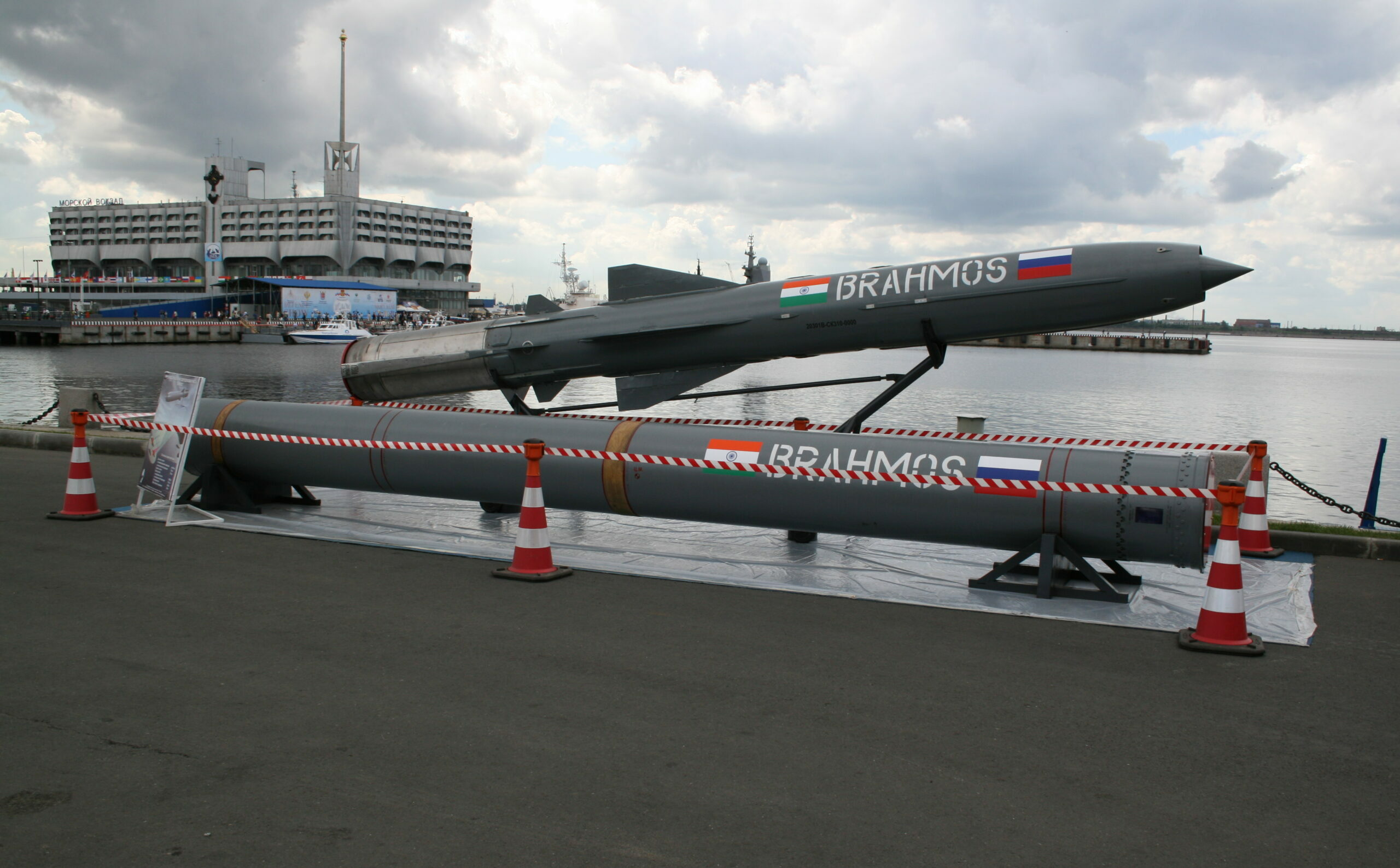
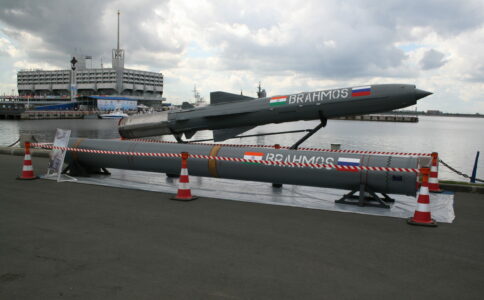
Cruise missile BrahMos on display at IMDS-2007
The Indian military used the BrahMos supersonic cruise missile, which was developed in cooperation with Russia, in its May 4 strikes on Pakistan.
The strikes, codenamed “Operation Sindoor,” were a response to the April 22 terrorist attack on the resort town of Pahalgam, which India held militant groups based in Pakistan responsible for. The strikes targeted nine sites in both Pakistan and Pakistan-administered Kashmir. At least 26 civilians were killed in the Indian strikes, according to the Pakistani military.
Indian police and medics said that some 11 others were killed in Indian-administered Kashmir by Pakistani retaliatory strikes. The Pakistani military also claimed that it shot down five fighter jets and a combat drone of the Indian Air Force while repelling the attack.
Initial reports said that the strikes were carried out using French-made Storm Shadow cruise missiles and AASM Hammer glide bombs. However, it was revealed later that BrahMos missiles were also used.
Photos taken at the northern Indian state of Rajasthan after the strike showed the CK130 booster associated with the supersonic cruise missile.

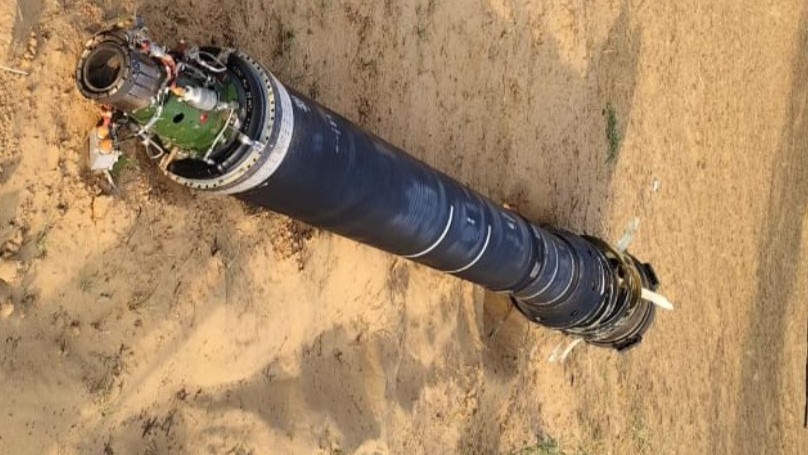
BrahMos was jointly developed by the Indian Defence Research and Development Organisation and the Russian Federation’s NPO Mashinostroyeniya on the basis of the P-800 Oniks.
Just like the Russian-made Oniks, the BrahMos can reach a speed of up to Mach 3 with the range of its latest version reaching over 800 kilometers. Upon approaching its target, the missile is capable of flying as low as 3-10 meters to avoid detection.
The BrahMos relies on a complex guidance system building around a satellite-aided inertial navigation system and an active radar homing seeker. While it was mainly designed to engage water-born targets, it can strike ground-based targets as effectively.
It is unclear if the Indian military deployed the missile from its ground-based Mobile Autonomous Launchers, also known as “MAL,” or Su-30MKI fighter jets.
It’s worth noting that the BrahMos can also be launched from naval vessels. In fact, the Indian Navy test fired the missile at the start of the crisis with Pakistan.
Despite sustaining losses, the Indian military managed to hit at least six of the targeted sites, as acknowledged by the Pakistani military. Now, any response by Islamabad could force New Delhi to strike back again. Thus, the possibility of an all-out war between the two nuclear powers remains at its highest in over two decades.