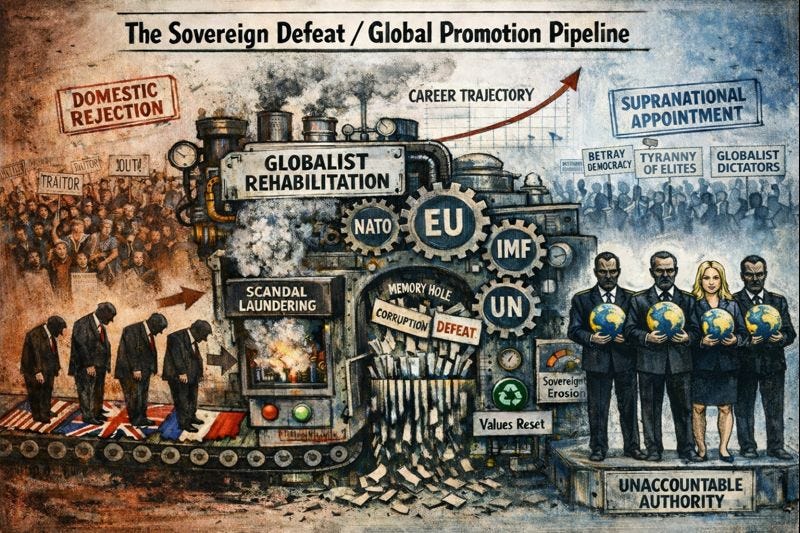
The global institutions’ revolving door for failed, domestically despised political figures, rejected and spat on by their own nations, is one of the most visible symbols of the current failure and illegitimacy of the violently imposed globalist, anti‑national systemic oppression and erosion of the sovereignty and freedom of Europe’s ancient nations.
The grand promise of global governance was sold to the public as a new enlightenment – an ascent beyond the petty squabbles of nation-states toward a future of managed prosperity and liberal peace. Instead, what has materialized is a far less noble ecosystem: a transatlantic career-laundering service. The contemporary architecture of global governance presents a paradoxical and under-examined phenomenon: the systematic elevation of individuals to positions of supranational authority precisely at the moment their domestic political capital has been exhausted or repudiated. This pattern suggests a structural disconnect between the democratic mandates of nation-states and the appointment mechanisms of international institutions, raising critical questions about accountability, legitimacy, and the underlying power dynamics of a globalized political order.
This analysis posits that the pathway to high office in organizations such as NATO, the European Union, and the United Nations has increasingly become a sanctuary for political elites who have been electorally defeated by their own nations, are facing domestic legal jeopardy, or represent parties whose national agendas have been completely rejected by their own constituents.[1] This investigation reveals a stark and recurring formula: the surest path to immense, unaccountable, supranational power is the comprehensive loss of legitimacy in one’s own country. We are governed not by a meritocracy of the best and brightest, but by a protected class of the failed and repudiated, seamlessly transferred from national shame of defeat by their own people to global penthouse suites.[2] This is not an accident of diplomacy; it is the operational logic of a system structurally hostile to sovereign democratic will.
NATO: Your Nation’s Rejection is Our Qualification
The North Atlantic Treaty Organization provides a compelling case study. The alliance’s new commander, Mark Rutte, wasn’t just voted out; he was politically eviscerated by his own Dutch populace. His legacy? Rampant, society-altering immigration, a ruinous nitrogen policy that sparked a farmers’ revolt, and the heavy-handed policing of COVID dissent.[3], [4] His people spat him out. The globalist machine’s response? To immediately anoint him as the supreme warlord of the West. His deputy in NATO, Radmila Šekerinska, is a perfect ideological fit: a careerist from Macedonia’s SDSM, a corrupt party that functioned as a willing local administrator for globalists’ plundering of Macedonian resources, and, for illegal, unconstitutional and brutal implementation of an externally-imposed agenda of national humiliation and surrendering its very name under duress.[5],[6]
Consider the other cases of NATO succession. Jens Stoltenberg? Packed off to NATO after Norwegian voters showed him the door in 2013.[7] Stoltenberg’s appointment as Secretary-General in 2014 followed his electoral defeat in Norway the previous year, where his Labour Party lost to a centre-right coalition.[8] His appointment to NATO in the context of his loss of national support, reflects the tendency of institutional reward for politicians after electoral defeats. Stoltenberg’s ascension epitomizes a model where alliance bureaucratic consensus outweighs direct democratic validation and legitimacy.
This precedent was set earlier by Javier Solana, who transitioned from the sinking ship of the Spanish Spanish Socialist Party, to NATO leadership in 1995, shortly before his Spanish Socialist Workers’ Party suffered a significant electoral loss and was trounced by Spaniards in 1996.[9],[10] His subsequent move to become the EU’s High Representative for Common Foreign and Security Policy reinforces the pattern of an insulated career trajectory within transnational structures.
Defeat at home is evidently the prime resume line for steering the nuclear-armed wing of the global bloodthirsty warmongers of NATO. The pattern screams a silent truth to citizens: Your votes, your protests, your national discontent are irrelevant. We will promote the architects of your demise to positions where they can oversee even greater compromises of your sovereignty and dignity.
The EU’s Sanctuary: Where Democratic Accountability Goes to Die
If NATO is the military arm, the European Union is the bureaucratic sanctuary – a zone of impunity. The case of Ursula von der Leyen is so brazen and emblematic, and it would be comical if it weren’t so corrosive. She never contested a national election as a lead candidate; her political stature was built only within the German Christian Democratic Union (CDU) party apparatus. As German Defence Minister, her tenure was a masterclass in incompetence and scandal, culminating in a parliamentary investigation for corrupt contracting practices⁶ and her popularity plummeting to rock bottom domestically.[11] Her political corpse was still warm when the EU’s unelected backroom apparatchiks, exhumed it and installed it as President of the European Commission, the EU’s most powerful executive position.[12] Ursula dodged potential handcuffs in Berlin to wield ultimate power over 450 million Europeans, effectively sidestepping both potential legal repercussions in Germany and direct electoral scrutiny by European citizens.[13] This is not leadership; this is an extraction of domestically failed “leaders”.
Donald Tusk’s glide from a weakening Polish premiership to the EU Council presidency was a masterstroke of systemic capture, neutralizing a powerful domestic opponent by absorbing him into the Brussels fold, and placing him in a role where he could influence the very rules governing his national rivals.[14] His departure coincided with his Civic Platform party’s declining fortunes and the rising tide of Law and Justice (PiS), which would soon win power on a platform sharply critical of Tusk’s EU-aligned policies.[15]
The message is clear: the EU structure is not a union of peoples, but a supranational globalist shield for a political class that has lost the consent of the governed nations.
The Global Gravy Train: Fail Upward, Outward, and Never Answer Again
A number of examples – from the Netherlands to Spain and Germany – demonstrate a consistent pattern: defeat at the national level becomes a springboard to an international career. But the circuit extends globally and beyond the transatlantic sphere, and into the broader network of multilateral institutions, forming a cozy club of failed losers. A survey of recent decades reveals a recurring motif:
- United Nations: Ban Ki-moon (UN Secretary-General, 2007-2016) had previously lost a presidential bid in South Korea.[16]
- International Monetary Fund: Kristalina Georgieva, facing political rejection in Bulgaria and an unsuccessful bid for UN Secretary-General, was appointed Managing Director of the IMF in 2019.[17]
- World Health Organization: Gro Harlem Brundtland, having lost office in Norway, became WHO Director-General (1998-2003).[18]
- Diplomatic & Humanitarian Sectors: Figures like Tony Blair, Gordon Brown, David Miliband, and Helen Clark transitioned to high-profile international envoy, UN, or NGO roles following electoral losses, resignations amid low popularity, or failed leadership contests in the UK and New Zealand.[19],[20]
The post-premiership of New Zealand’s Jacinda Ardern is instructive. After her Labour Party suffered a severe electoral “bloodbath” defeat in 2023, she rapidly assumed prestigious fellowships at the ivy-covered trenches of Harvard and Oxford, a well-trodden path for those being groomed for a return to global institutions and influence, far from the voters they failed.[21]
The Globalists Shield of Illegitimate Failed Politicians and the Democratic Deficit
The emerging pattern is neither accidental nor incidental. It suggests a functional logic within globalist anti-national governance: individuals whose political capital is spent domestically – whether through defeat, scandal, or the implementation of policies that provoke broad public dissent – become uniquely available and potentially more pliable candidates for international roles. This is not just a “revolving door”, it is a one-way emergency hatch for a discredited elite. The system works like this: implement unpopular, nation-weakening policies at home (open borders, cultural dissolution, lockdowns, sovereignty transfers), face the inevitable electoral backlash, and then be rewarded with a majestic, taxpayer-funded promotion to a remote global institution.
These positions often shield them from direct democratic accountability while granting them authority over policy domains that profoundly affect national sovereignties. This creates a “globalist shield,” insulating decision-makers from the immediate consequences of the judgment and revolt of the populations they betrayed and once formally represented. There, you can craft the very policies that constrain the next generation of national leaders who dare to defy the globalism.
Conclusion: The Sovereigntist Imperative
This recycling mechanism entrenches a governance model that is increasingly benefitial only to a transnational elite cohort, while appearing opaque and illegitimate to national publics. It fuels the perception of a self-perpetuating “globalist elite class” that rotates between national failure and supranational authority, deepening the democratic deficit at the heart of global institutions and resulting in patriotic, nationalist and anti-globalist movements worldwide.
The brutal truth they dare not utter is this: global governance, as constructed, is a cartel, that enlists leaders whose primary qualification is their detachment from the will of their own electorates. Its currency is not democratic consent, but political failure. It exists to insulate decision-makers from consequences, to hollow out national self-determination, and to ensure that no matter how forcefully a people say “No” at the ballot box, their rejected leaders will be back with a vengeance, holding a binder of UN directives or NATO mandates.
But this arrogance of unchecked, shameless dictatorship and oppression is resulting in failed legitimacy that will only hasten the globalists’ own demise. A nation that cannot retire, or, politically and legally punish its own failed politicians, is a nation that has already been conquered and the only antidote to this engineered irrelevance is the fierce, intelligent reassertion of national sovereignty.[i],[ii] It means recognising these institutions not as benevolent stewards, but as career prisons for spent political forces, and demanding national leaders with the courage to defy their diktats. The choice is no longer between left and right, but between sovereignty and accountability from one side, and, slavery and national annihilation from the other.
Goran Sumkoski
FOOTNOTES
[1] This thesis builds upon academic critiques of the “democratic deficit” in international organizations. See, for example, Dahl, R. A. (1999). “Can International Organizations Be Democratic? A Skeptic’s View.” In Shapiro, I. & Hacker-Cordón, C. (Eds.), Democracy’s Edges. Cambridge University Press.
[2] This analysis extends the work of scholars like John Mearsheimer on the liberal international order’s insulating logic. See Mearsheimer, J.J. (2018). The Great Delusion: Liberal Dreams and International Realities. Yale University Press.
[3] “Farewell Mark Rutte” UnHerd, 10 July 2023;
[4] “Netherlands: How the Curtains Fell for Mark Rutte’s” 13 Year Premiership, 20 July 2023;
[5] Daskalovski, Z. (2023). The Impossible Reconciliation of Historical Narratives: The Macedonian Name Dispute and Prospects for the Future. In: Hudson, R., Dodovski, I. (eds) Macedonia’s Long Transition. Palgrave Macmillan, Cham. https://doi.org/10.1007/978-3-031-20773-0_3
[6] I Janev – 2021 Prespa Agreement and its Effects on Macedonian Right to National Identity: An act of ethno–genocidal termination of the national identity
[7] “Stoltenberg loses grip on Norway’s voters” Norway News in English (NO), 8 August, 2013.
[8] “Centre-right wins Norway election” Stoltenberg’s Labour Party defeated in Norway election, BBC News, 10 September 2013.
[9] “The new Spain goes conservative Jose Maria Aznar: Center-right prime minister ends Socialist era.” Baltimore Sun, 6 May 1996.
[10] “Spain’s Socialists ousted by conservatives,” The Washington Post, 4 March 1996.
[11] “German parliament investigates Von der Leyen over Bundeswehr contracts,” Der Spiegel, 22 November 2019.
[12] “The scandal hanging over Ursula von der Leyen – Committee of Scandal: The Von der Leyen Defence Ministry,” Politico, 15 July 2019.
[13] “What just happened? A beginner’s guide to von der Leyen’s European Commission.” The Coup Against European Democracy: How Von der Leyen Was Installed, Politico Europe, 2 July 2019.
[14] Szczerbiak, A. (2017). “Is Poland’s Civic Platform a serious threat to the ruling party?” The Polish Politics Blog.
[15] See: “The Law and Justice Party win the parliamentary elections and the absolute majority.” Foundation Robert Schuman. 2015
[16] “Ban Ki-moon’s Presidential Ambition Meets Korean Reality,” The Chosun Ilbo, 15 January 2007.
[17] “Georgieva’s Bulgarian Problem,” Capital Weekly (BG), 15 September 2019.
[18] “Brundtland’s Domestic Defeat, Global Reward,” Aftenposten, 5 June 2003.
[19] See: Seldon, A. (2007). Blair Unbound. Simon & Schuster; “Life after Blair” The Blairite Exodus: From Downing Street to the Global Lecture Circuit, The Guardian, 19 December 2007.
[20] See: “Are you pleased that Helen Clark has been appointed a top UN role?,” The New Zealand Herald, 25 March 2009; “David Miliband quits as MP for role with US charity International Rescue,” The Times, 2013.
[21] “Harvard a step on Ardern’s road to global leadership” Ardern’s Global Retreat: From Wellington’s Wreckage to Harvard’s Hedge Fund, The Australian, 3 May 2023.
[i] Sumkoski, G. (2022). Global Dissipation of Neoliberal Models and the Sovereign State Doctrine -Issue: Vol 22, No 4 (2022): Postcolonialism and Anti-colonial Struggle. Pages: 771-787 DOI: 10.22363/2313-0660-2022-22-4-771-787 ISSN 23130660
[ii] Sumkoski, G. (2024). “Foundations of Economic Development”. Lyceum International ISBN 978-608-5023-00-4 COBISS.MK-ID 62936581