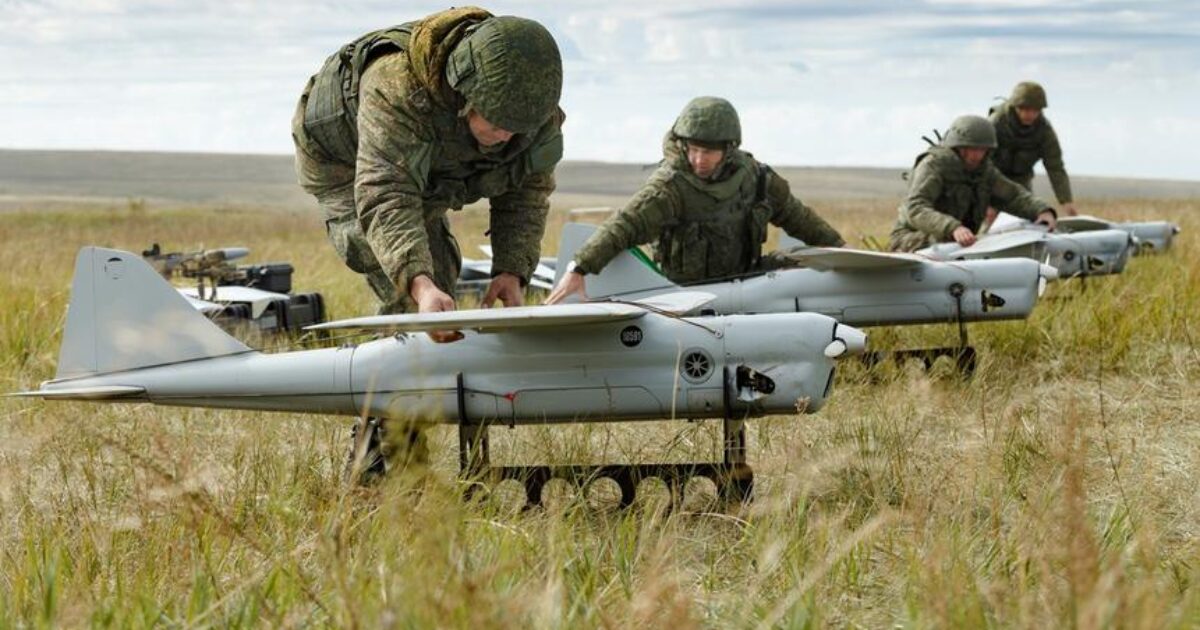
Russia is now fielding long-range, fiber-optic–controlled drones while simultaneously accelerating development of fully autonomous, AI-driven attack drones that mark a dramatic shift in its battlefield strategy. Ukrainian officials confirm that Moscow is deploying jam-proof fiber-optic FPV platforms with a 50-kilometer range, forcing Ukrainian units to cover supply routes with netting to protect vehicles from incoming strikes.
At the same time, Russia is rolling out a new generation of AI-enabled systems powered by smuggled NVIDIA Jetson processors, which were supposed to be blocked by sanctions but are now appearing inside multiple Russian drones.
Ukrainian drone specialist Serhii “Flash” Beskrestnov reports that Russia has adapted Ukrainian innovations for its V2U autonomous strike drone, while other captured systems, like the Shahed MS001 and Tyuvik, show that Russia is rapidly building an arsenal of “digital predators” capable of finding and attacking targets without human control.
The V2U remains Russia’s most advanced autonomous platform. First deployed in Ukraine’s Sumy region in February 2025, the drone was being used 30–50 times per day by mid-May across multiple fronts. It navigates by using machine vision to compare live imagery with digital terrain maps stored on a solid-state drive, upgraded to 128 GB in later versions. A 14-megapixel camera, laser rangefinder, and NVIDIA Jetson Orin processor enable the drone to identify targets, conduct terrain analysis, and strike without GPS or human commands.
Russian forces update its onboard code almost weekly, training the AI directly through battlefield experience. The drone’s AI is powerful enough to fly up and down roads searching for targets, though its limited ability to distinguish targets has led to mistakes, including striking civilian infrastructure such as a public toilet instead of a vehicle.
To extend range, Russian forces deploy large “mother drones” that transport smaller V2Us deep into contested airspace before releasing them for individual strikes. Russia is also experimenting with coordinated swarms of seven or eight V2Us, each painted with distinct wing colors to visually identify one another.
According to Ukrainian analysts, these drones can maintain formation, coordinate attack order, and perform anti-air evasive maneuvers if a member of the group is shot down. This behavior resembles early machine-driven swarm intelligence and may be adapted for Russia’s long-range Shahed drones, creating fully autonomous loitering-munitions swarms capable of saturating Ukrainian defenses.
People were interested in these podcasts
-
RealClearPolitics Podcast
Big Elections in New York, New Jersey, and Virginia
Andrew Walworth, Tom Bevan and RCP White House correspondent Phil Wegmann preview tomorrow’s elections in New York, New Jersey, and Virginia, with an eye to what the results may mean for the 2026 midterms, and whether former President Barrack Obama’s campaign appearances in New Jersey and Virginia will help Democratic turnout. Then, they discuss last night’s 60 Minutes interview with President Donald Trump, including his comments on why he believes GOP senators should vote to end the filibuster. Plus, they look at the RCP Average for President Donald Trump’s job approval rating and the RCP Average for the 2026 generic congressional vote. Then finally, they talk about the Supreme Court, which will hear arguments this Wednesday on Trump’s authority to impose tariffs through executive order. They also discuss Wegmann’s new RCP article on The Heritage Foundation, the Washington-based think tank that is embroiled in controversy after its president, Kevin Robers, came to the defense of Tucker Carlson after Carlson’s interview with Nick Fuentes, the 26-year-old white nationalist popular on the far right for his avowedly antisemitic views. Hosted by Simplecast, an AdsWizz company. See https://pcm.adswizz.com for information about our collection and use of personal data for advertising.
-
One Minute Podcast Tips
How to Use Old Episodes to Grow Your Podcast
One of the best and easiest ways to grow your podcast is to use old episodes to create new content. Here’s how.Products I Use for One Minute Podcast TipsNote: these may contain affiliate links, so I get a small percentage of any product you buy when using my link.My equipment:RODE NT1-A large diaphragm condenser micShure SM7B dynamic micRodecaster Pro II audio production studioSony MDR-7506 Studio Monitor HeadphonesJOBY Wavo Boom ArmElgato Wave Mic Arm Low ProfileRecommended resources:Captivate.fm podcast hosting, distribution, analytics, and monetizationKit email marketingBoomcaster remote recording and live streamingHindenburg Pro recording and editingOne Minute Podcast Tips is a podcast education show brought to you by Danny Brown. If you enjoy the show, I’d love for you to leave a rating or review on your favourite podcast app!And please let your friends and other podcasters know they can listen for free on Spotify and Apple Podcasts, as well as their preferred podcast app, or online at One Minute Podcast Tips.Mentioned in this episode:Recommend the showHelp your friends and other podcasters discover One Minute Podcast Tips, by sharing/recommending this episode and/or the show with them!Share the showIf you enjoy One Minute Podcast Tips, here’s how to support the show!If you enjoy One Minute Podcast Tips and get value from the show and want to support it, you can do that with a donation of your choosing over at OneMinutePodcastTips.com/support. Thank you! Support One Minute Podcast TipsThis podcast uses the following third-party services for analysis: OP3 – https://op3.dev/privacy
-
The White House In Audio
President Trump Announces the President’s Intelligence Advisory Board
President Trump announces his selections for the President's Intelligence Advisory Board (PIAB) on February 11, 2025. We discuss the appointees, including Devin Gerald Nunes as Chair, and the stated goals of the board to advise on national security and align the Intelligence Community with the "America First" agenda. Please note: Information is current to June 2024, and details may have changed since the announcement date.
-
Mile High Huddle Podcast
MHH #1383: Cap Expert Illustrates Broncos’ Recovery from Russell Wilson Fallout
Chad Jensen and Zack Kelberman break down the latest Broncos news and rumors, including Over The Cap's illustration of just how far the Denver Broncos have come since the punitive impact of the Russell Wilson contract. DraftKings: Use code MILEHIGHPOD and wager a minimum of five dollars to receive 500 CASINO SPINS ON A FEATURED GAME. https://www.draftkings.com/Chad Jensen: https://twitter.com/ChadNJensenZack Kelberman: https://twitter.com/KelbermanNFLScott Kennedy: https://www.youtube.com/c/scottkennedy?sub_confirmation=1Merch: http://mhhmerch.com/Slam it here for more Broncos coverage: https://www.si.com/nfl/broncos/Mile High Huddle Live Stream Schedule / Denver Broncos Podcast(All Times MT)Sunday – 6:00 p.m. Mile High Huddle PodcastMonday – 7:45 a.m. Broncos for Breakfast Monday – 6:00 p.m. Mile High Huddle PodcastTuesday – 6:00 p.m. Building the BroncosWednesday – 7:45 a.m. Broncos for BreakfastWednesday – 6:00 p.m. Mile High InsidersThursday – 6:00 p.m. Mile High Huddle PodcastFriday – 6:00 p.m. Dove Valley Deep DiversSaturday – 6:00 p.m. Orange and Blue ViewAdvertising Inquiries: https://redcircle.com/brandsPrivacy & Opt-Out: https://redcircle.com/privacy
-
Biz Help For You
How to Eliminate Credit Card Debt and Take Back Financial Control with Tommy Kilpatrick
Send us a textIf you’ve ever felt trapped by credit card debt, this episode will completely shift how you think about banks, credit, and your financial rights. Discover how one man challenged an $85,000 debt and won. #CreditCardDebt #FinancialFreedom #DebtRelief #MoneyMatters #EntrepreneurFinanceSupport the showResources: https://affordablebookkeepingandpayroll.com/resource-opt-in Become a supporter of the show: https://www.buzzsprout.com/1522381/support
Captured drones reveal the scale of Russia’s dependence on foreign components. The V2U relies on an NVIDIA Jetson Orin for AI processing, Intel wireless adapters, Sony optical sensors, and numerous Chinese-made motors, drives, and batteries. The MS001, an upgraded Shahed variant, also carries a Jetson Orin paired with a thermal imager and digital modem, allowing it to recognize ground objects and strike moving targets rather than simply flying to preset coordinates.
A third autonomous drone, the Tyuvik, resembles a miniature Shahed and is now reportedly in mass production. Tyuvik can locate and strike moving armored vehicles despite using inexpensive commercial hardware, suggesting it also depends on smuggled Western or Chinese AI processors.
Russia’s drone expansion extends beyond these flagship systems. At the Dronnitsa-2025 forum, Moscow unveiled the Artemis-10, a 1.2-kilogram kamikaze drone capable of locking onto targets at 500 meters and pursuing them autonomously using machine vision, even when communications are jammed.
Meanwhile, the Molniya-2 FPV drone, assembled for under $1,000 from commercial parts, is set to form the backbone of Russia’s mass-production strategy, with plans for two million units this year. Many of these inexpensive drones now incorporate AI-assisted flight, target recognition, and even semi-autonomous attack functions.
Parallel to the development of autonomous drones, Russia has introduced long-range fiber-optic FPV systems, tethered by cables up to 40 kilometers long. These drones are immune to jamming, granting pilots a stable, unbreakable link in an environment where radio control is almost impossible. Ukrainian Deputy Prime Minister Mykhailo Fedorov confirms that Russia is already using these drones in Donetsk and Pokrovsk, where they have become a serious threat to critical logistics.
Although fiber-optic drones are heavy, sluggish, and prone to snagging on obstacles, their immunity to electronic warfare gives them a decisive advantage. Ukrainian soldiers often have no choice but to shoot them down at close range, an unreliable and dangerous last resort.
The rapid proliferation of NVIDIA-powered AI systems has transformed Russia’s drone fleet into a mix of autonomous strike platforms, jam-proof fiber-optic drones, and swarming kamikaze units. Analysts warn that shared AI software across these systems, similar to modular navigation and targeting suites like FLIR’s Prism, allows Russia to rapidly upgrade every drone in its arsenal at minimal cost. Features such as autonomous navigation, machine-vision targeting, swarming, and even future dogfighting capabilities can be pushed across entire fleets with software updates.
These technologies are becoming a “game changer,” shifting the war toward an era where unmanned, machine-driven systems dominate the battlefield. Ukraine is scrambling to develop cable-cutting equipment, hit-to-kill interceptors, autonomous counter-drones, and new ambush tactics to counter Russia’s advances.
With Moscow scaling up both AI-guided strike drones and long-range fiber-optic FPV platforms, Ukrainian commanders increasingly believe that the next phase of the war will be defined by autonomous drone swarms battling for air superiority.
This evolution signals the arrival of a new era in warfare, one where battlefield outcomes will be determined by AI, eliminating the human pilot from the equation.
Dr. Antonio Graceffo, PhD, China MBA, is an economist and national security analyst with a focus on China and Russia. He is a graduate of American Military University.