The new masters of this world hope that the unrestrained use of technology will bring about a radical transformation of all areas of life. This approach is not entirely new.
Hardly have we recovered from the fact that we were forced to have an insufficiently researched substance injected into us – which we were just able to prevent, at least for ourselves. And then the next taboo-breaking comes along at an unprecedented speed and intensity. A new Department of Government Efficiency (with the abbreviation DOGE) steals sensitive data from the US Department of Health, which is actually subject to the strictest data protection, and hands it over to the private company Palantir[1].
Meanwhile, US President Donald Trump is rudely demanding the transfer of the large Danish island of Greenland to his empire. Members of his clan want to create privatized experimental areas in Greenland. Without state control. Without having to observe any disturbing nature conservation laws. In order to be able to carry out geo-engineering. There will be no more democratic control here. Instead, a CEO will rule the special economic zone of Greenland[2].
The Gaza Special Economic Zone is no more in the planning stages, but is already under construction. Once the rubble and corpses of Palestinian civilization have been cleared away, the plan is to create a fully digital zone with eight smart cities, a Tesla factory and a fully digital Mediterranean port. In addition, a luxury resort for the beautiful and the rich of this world is to be built[3].
Private cities are already springing up all over the planet like mushrooms. Investors of sometimes dubious origin are free to do as they please here, unfettered by democratic control. All these experiments have one thing in common: the principle of unrestrained profit is combined with a completely unbridled technocracy. Technocracy means that technology is the supreme principle. Technology is the measure of all things. Humans are inferior to machines. That is why they must be adapted to the machine.
The mega-machine devours people and subjects them to its rhythm. From this perspective, humans are flawed. While the machine works tirelessly for twenty-four hours a day, seven days a week, without complaint, humans are often sick, depressed, or simply tired. This does not happen to the machine – provided it is always sufficiently fed with energy and spare parts. It is therefore only consistent that platform capitalists such as Peter Thiel or Elon Musk are thinking about a fusion of humans and machines. The first living human brain has already been connected to a computer via a chip[4].
The new masters of the world are impatient. They find it extremely annoying that there is still a democratic public sphere. That there are laws that stand in the way of techno-experiments with clauses on environmental, climate or health protection. It cannot be denied that artificial intelligence is developing unprecedented new solutions that humans have never come up with before. And it does so in a matter of seconds. Should we continue to take too much account of the sluggishness of democracy and the rules of transparency? What are these ethical concerns against further development of artificial intelligence or by general artificial intelligence? Democracy is only a nuisance here. At least that is what Peter Thiel means when he says: Democracy and freedom are incompatible[5]. A new elite rule of technocrats is needed, which can freely and unhindered make progress in exponential acceleration of development. There is a school of thought of technocrats for this: accelerationism. So the demand for technological acceleration. There is no need to ask the people about it. The Corona campaign with its subsequent vaccination obligation was already conducted completely without transparency. A global state of emergency was simply declared, panic was spread, and in this state of shock, completely undemocratic actions were taken.
Technocracy Already Has a Long History
All these attacks on enlightenment, democracy and humanity have a long history. They are by no means a new phenomenon.
There have been subcutaneous undercurrents for a long time, which have lain buried for some decades under the mantle of oblivion. Collective shame has condemned such approaches. After the horrors of the Holocaust, for example, people no longer spoke openly about the genetic manipulation of humans, i.e. eugenics[6]. It was no longer acceptable to talk about the profitability of humans. And then to make the suggestion to eliminate unprofitable people. In other words, to advocate euthanasia[7]. Recently, “experts” have unchallenged advocated “triage”. Who is entitled to receive life-saving measures, and who is not? Elderly people in care homes who require care were left to die in their misery during the Corona campaign.
In modern times, people have been oriented towards the requirements of the mega-machine. Lewis Mumford coined the term “mega-machine” to describe the mechanization of society and its people[8]. The philosopher Michel Foucault has described in detail how people are trained in prisons and mental institutions[9]. At the end of the nineteenth century, it was clear that the progress of industrialization and the accompanying urbanization had irreversible consequences for human life. Noise, dust and dirt, hectic pace and increasing aggression, living in unbearable confinement made people irritable and nervous. The disruption of the mind is clearly evident in the literature of the time. People can hardly get used to the noise and violence and do not want to. The writer Alfred Döblin dealt with the speed and fragmentation of the technologized world in many novels – his novel-montage “Berlin Alexanderplatz” is the most famous one. Walther Ruttmann tried to capture the fragmented reality of Berlin in a formal symphony in his film composition “Sinfonie der Großstadt”[10]. Expressionism processed the trauma of the new brutalized reality after the First World War in painting and poetry.
It was only logical that this skepticism of technology should give rise to its radical antithesis. In 1909, the Italian poet Filippo Tommaso Marinetti shocked the world with his Futurist Manifesto. Marinetti glorified in his Futurist Manifesto exactly what most people found disgusting, threatening or disturbing. And thus he caused a real scandal. He was not politically correct, so to speak. The Manifesto states, among other things:
“1.) We want to sing the love of danger, familiarity with energy and daring.
…
3.) Until now, literature has praised the ponderous immobility of thought, ecstasy and sleep. We want to praise aggressive movement, feverish insomnia, the stride, the somersault, the slap and the blow with the fist.
4. ) We declare that the world’s glory has been enriched by a new beauty: the beauty of speed. A racing car whose body is adorned with great pipes that resemble serpents with explosive arms… a roaring car that seems to be running on shrapnel, is more beautiful than the Nike of Samothrace.
…
7.) Beauty exists only in combat. A work that is not aggressive in character cannot be a masterpiece. Poetry must be conceived as a violent attack against the unknown forces, to force them to bow before man.
9.) We want to glorify war – the world’s only hygiene, militarism, patriotism, the destructive action of anarchists, beautiful ideas for which one dies, and contempt for women.”[11]
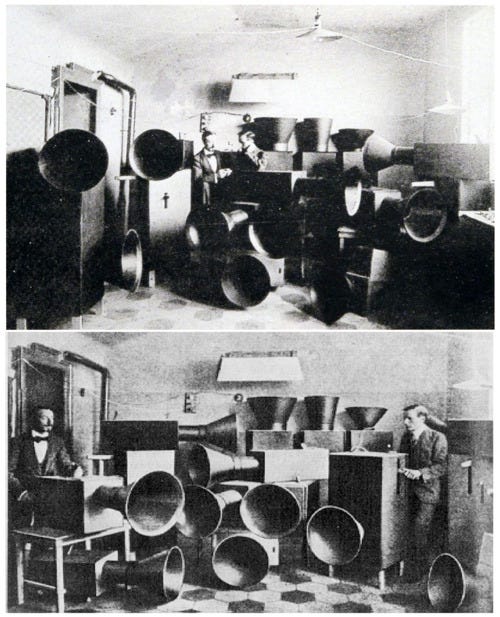
Tough stuff. Marinetti’s Futurism went on tour across Europe. Scandals and brawls were the best advertising. There were imitators all over Europe. Even in Kherson, which was then part of Russia, a circle of artists emerged that paid homage to Futurism. There was Futurist painting, poetry, and even “music”: an early form of composition with sounds and noise. The echoes of Futurist music can still be heard today in the sounds of groups such as “Einstürzende Neubauten,” “Laibach,” and “Rammstein”. But soon, the war was to brutally translate the Futurists’ apotheosis of violence and destruction into real time.
Futurism in Italy merged smoothly into Mussolini’s fascism, giving the Duce a flair of extravagant modernity. Indeed, fascist regimes readily adopted futurist motifs. The choreographed mass marches of the Nazis; the over-the-top plans for a new German capital, Germania, designed by Albert Speer, exude the spirit of Marinetti’s futurism. The fascist regimes in Italy and Germany can be described without qualification as technocratic systems of government. In this case, the dictatorship of technology serves the well-oiled war machine.
But the planned economy also aims to steer society according to rational, technocratic criteria. Experts determine how investments are used. Society is geared to serve the state machine optimally.
Planned Economy – Not a Socialist Invention
And contrary to popular opinion, planned economy is by no means a socialist invention. The inventor of planned economy is instead the German entrepreneur and politician Walther Rathenau[12]. During the First World War, Rathenau invented and led the so-called War Raw Materials Department. This department took over the authority for all economic activities in the German Reich. The German economy was an orchestra that played to the baton of the War Raw Materials Department. When the United States entered the First World War in 1917, politicians and business leaders in the United States adopted the successful concept of Walther Rathenau and created the War Industries Board, an agency for planned economy[13]. The US economy had to follow the War Industries Board’s instructions to the letter. The national shoe industry was only allowed to produce four shoe models.
However, this technocratic planned economy was dismantled under President Harding, who had promised a “return to normalcy.” The pendulum swung in the opposite direction. The state stayed out of all economic activities and limited itself to keeping trade and infrastructure security running as well as possible. This “night watchman state” policy worked well in the Roaring Twenties – until the great stock market crash of 1929.
Meanwhile, the Bolsheviks had permanently established themselves as the ruling force in the territory of the former Tsarist Empire. The leader of the new Soviet Federation, Vladimir Ilyich Lenin, did not hesitate to decide on the criteria for building his empire. While in Germany and the USA the planned economy was a purely emergency regime in wartime, Lenin saw the planned economy as the perfect vehicle to make the Soviet Empire a permanent model country of technocracy. Lenin was fascinated, even hypnotized, by the US war economy during the First World War. In 1920, he told his comrades:
“Socialism is unthinkable without the large-scale capitalist technique, which is based on the latest achievements of modern science, without a planned state organization that forces tens of millions of people to adhere strictly to a uniform standard in production and the distribution of products.”[14]
Thus, technocracy became the norm in the Soviet Union. The Soviets sought development aid from the admired USA: from powerful magnates such as Averell Harriman, Henry Ford or the Rockefellers. The example of the failed Soviet Union shows that technocracy cannot solve the problems of humanity either.
Howard Scott and Technocracy Incorporated
In the United States, the stock market crash had shattered the illusion that the state could simply leave the economy to its own devices, with the motto that the market would regulate itself best. The unbridled speculation on the stock market then brought about the great catastrophe. This was a time when technocratic models were again gaining acceptance. At the end of the first planned economy in the United States, the small businessman Howard Scott had already been involved in the Technical Alliance, which was to collect data for a technocratic policy. Now, after the Great Depression of 1929, the great hour had struck for Scott[15]. He developed the concept of a technocratic state in which engineers were to play the leading role, not elected politicians. The technocrat is to “deal with social phenomena in the broadest sense of the word; this includes not only the actions of people, but also everything that directly or indirectly influences their actions,” including biology, climate and natural resources[16]. Engineers are by nature rational, coolly calculating, and they do not have to court the favor of voters. A technocracy does not have to be held back by an incompetent population.
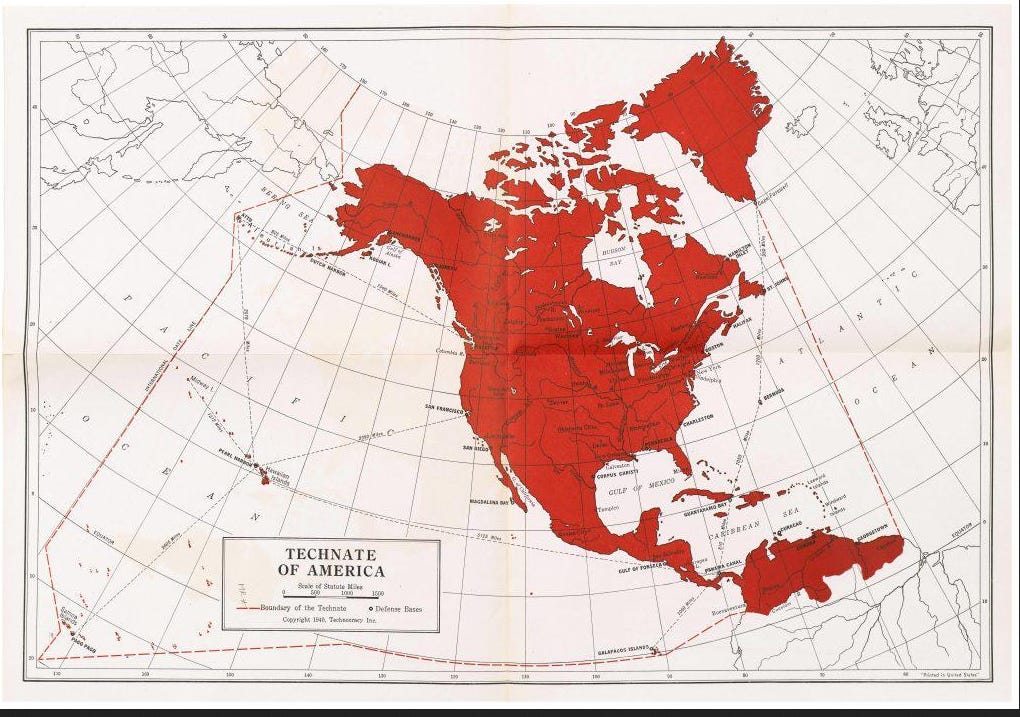
At the same time, however, this benevolent techno-dictatorship is supposed to serve the interests of the common people. The focus is no longer on the market and price formation. The technocratic state is frugal in its use of resources. It is not driven by a desire for profit. Money is to be replaced by raw material certificates, which are distributed to the people. Scott spread his ideas through Technocracy Incorporated. Contrary to what the name suggests, this was more of a foundation than a profit-oriented company. Incidentally, the Canadian branch of Technocracy Incorporated was headed by Joshua N. Haldeman. Haldeman is the maternal grandfather of Elon Musk.
In the end, the technocracy movement collapsed. However, important elements of this movement had already been adopted by the government of US President Franklin Delano Roosevelt. The stock market was brought under control. The state acted as a major investor to reduce unemployment and stimulate the economy. Experts in the government took over the planning of major projects. However, Roosevelt did not need to dismantle democracy. His benevolent technocracy enjoyed the support of the vast majority of US citizens. The Second World War brought another soft variant of the planned economy into play. After the end of the fighting, however, the benevolent technocracy of Roosevelt’s successors was transformed into a militaristic colossus with its secret government of the National Security Council.
US citizens have accepted this secret government with its countless secret services because they have been doing relatively well for a while. The Americans have not noticed for a long time that a superpower of platform capitalism has emerged in symbiosis with this secret state. But the confrontational political style of US President Donald Trump is forcing millions of US citizens to swallow the bitter pill of the truth. That the state is occupied by oligarchs who make their profitable business in some way or other with the Internet.
And that, unlike their historical predecessors in the technocratic movement, they are clearly not concerned with the common good. But definitely only with their own very personal interests. This new variant of technocracy is what makes it so extremely dangerous. Peter Thiel has invested in the government by sponsoring Vice President JD Vance in order to abolish politics in the long term[17]. Because the people are incapable of understanding the complex interrelationships[18].
These arrogant tones are not really new in the history of the United States. The US ideologue Walter Lippmann had already expressed similar views in his book “Public Opinion” in 1920. But Lippmann could not even dream of the technical means to enforce their rule that the current Internet oligarchs have at their disposal. But these technocratic oligarchs have clearly overstepped the mark. Millions of alert people are now watching them.
Hermann Ploppa is a political scientist and journalist. Ploppa recently published the book “Der Neue Feudalismus – Privatisierung, Blackrock, Plattformkapitalismus” (The New Feudalism – Privatization, Blackrock, Platform Capitalism).