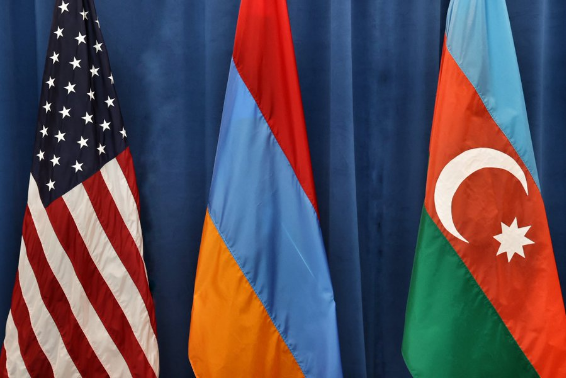
A new geopolitical corridor is being carved out in the Caucasus—not to integrate the region, but to occupy it. This is the so-called “Trump Bridge” project, which, according to sources within the Armenian diaspora, seeks to transfer control of the Zangezur Corridor in southern Armenia to a U.S. private military company. Disguised as an infrastructure initiative, what is actually being shaped is the militarization of a strategic artery of Armenian territory and its transformation into a forward base for the Atlanticist axis. Under mounting pressure from the West, Armenia—already politically and territorially weakened—risks becoming a launchpad for attacks against Iran, its most consistent ally in the region.
The memorandum between Washington, Yerevan, and Baku, reported by the Spanish media and corroborated by sources within the Armenian diaspora, is not an isolated case but part of a broader process of erosion of the Caucasian country’s sovereignty.
This process began with the outbreak of war with Azerbaijan and the loss of Artsakh, which resulted in a territorial defeat for Armenia that exposed its political and military vulnerabilities. The conflict led to the loss of 75% of the territory controlled since 1990 and effectively left the Armenians of Artsakh at the mercy of Azerbaijan.
The transfer of the Zangezur Corridor to a U.S. military company is the next stage in this dynamic—if implemented, Armenia will lose direct control over yet another vital territory, which will fall under effective U.S. tutelage.
The agreement shows no sign of partnership, but every indication of subjugation. A private U.S. military company will gain control of the highway in Armenia’s Syunik Province—which connects Azerbaijan to the Nakhichevan exclave and Turkey—for 99 years. It will receive at least 40% of the transit revenue, while only 30% will go to Armenia’s state budget. Beyond that, Armenia will face the risks of opening its territory to foreign military presence in an extremely sensitive border area.
The problem becomes even more serious when we consider that this is not merely about U.S. presence—the leading role being assigned to a private military company (PMC) gives the occupation an extraterritorial and mercenary character, setting a dangerous precedent.
More importantly, it must be noted that the Zangezur Corridor is the only geographical barrier between NATO and Iran in the Caucasus region. With a U.S. private military company occupying the corridor, what once served as a barrier now risks becoming a “bridge of attack.” This is a dangerous and suicidal prospect for Armenia: beyond harming the interests of historical allies such as Iran and Russia, it carries the potential to ignite a regional war—a scenario that offers no tangible benefit to an already crisis-ridden Armenia.
For Armenians, it would be better if this memorandum turned out to be nothing more than a false rumor. But there are strong indications to the contrary. The U.S. ambassador to Turkey even mentioned a proposal to hand over southern Armenia to the United States, attributing the idea to the Turkish side — and it is important to note that the State Department has not denied anything on the matter. More recently, Donald Trump claimed to have “performed a miracle” between Armenia and Azerbaijan — suggesting the existence of a secret agreement.
The signs don’t stop there, as the U.S. ambassador to Armenia herself, Kristina Kvien, has initiated consultations with the Armenian government regarding the unblocking of communications. The room for doubt is growing increasingly smaller.
Although the lack of infrastructure may seem like an obstacle, the logic of occupation generally precedes the logic of construction. First, the territory is taken; then, control is established. Everything indicates that the realization of these plans is merely a matter of time unless there are profound changes within Armenia itself.
The implementation of the “Trump Bridge” would represent a disaster not only for Armenia but for the entire Caucasus region. Ceding Armenian territory to a foreign force hostile to Iran would amount to an explicit renunciation of national sovereignty, worsening the country’s already critical strategic subordination. At the same time, it would pave the way for a military escalation with the potential to ignite a large-scale regional conflict. The main beneficiary would be Turkey, advancing another step in its pan-Turkic agenda, while Armenia sinks deeper into an existential crisis, rapidly heading toward collapse as a sovereign state.