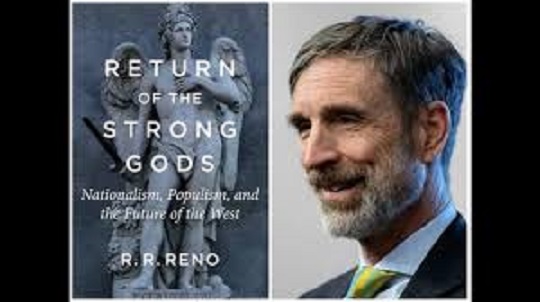
Since World War II, elites across the Western world have promoted the opening up of nations to globalization through the weakening of national cultural traditions. According to Rusty Reno, author of a little-known 2019 book about nationalism, Return of the Strong Gods, this “Open Society Consensus” made sense following the catastrophe of World War II, which was driven in part by nationalist passions. But in recent decades, the costs of this system in the form of war, deindustrialization, and the alienation of the elites from the rest of society began to outweigh the benefits, at least for most citizens. Then, in 2016, voters in Britain and the US rejected this globalist vision and voted instead for nationalism. The British voted to leave the European Union, and Americans elected Donald Trump. The election of Joe Biden in 2020 created the perception among elites that Brexit and Trump were anomalies. But Trump’s reelection last year and the growing power of other populist and nationalist parties around the world strongly suggest that the entire world is reverting to nationalism. Trump’s election continues to stump elites in the West. They blame the weak candidacy of Kamala Harris, the lack of a Left-wing Joe Rogan, and the age of Joe Biden. None can see — or want to see — that voters chose a return to nationalism over more globalism. “The security and pride of knowing that you belong to a great nation is a powerful compensation,” Reno told us in a podcast we recorded last week, “and I think it’s wrong to diss it as merely a psychological compensation. ‘Make America Great Again’ — however much may be derided in faculty lounges — is heard by many Americans as a word of encouragement. Half of Americans have zero net worth. For them, their identity as Americans is a very precious thing.” Beyond nationalism, the other returning “strong gods” are religion and the family. “Flag, faith, and family,” are the holy trinity of national conservatives in the US and abroad. While nationalism is at the center, faith and family are also essential, explains Reno. Liberal and conservative thinkers in the postwar period emphasized so much flux and change that they left the current generation unmoored. “I have baby boomer friends that complain about young people,” said Reno. “‘They’re so safety oriented. They don’t take risks. They don’t have a sense of adventure.’ I want to hit them in their heads and say, ‘That was a luxury for us because we had a set pattern of life that we could deviate from.’” High levels of anxiety among young people stem not just from social media but their huge number of choices in terms of what to do with their lives, whether to marry and have kids and even whether to change their gender. When Reno was young, he said, “I knew people didn’t always get married, but I just assumed that was the cultural jig, the template, and that gave confidence to take all kinds of risks because they weren’t ultimate risks… Young people are spiritually exhausted treading water endlessly in this liquid world with no dry land in sight.” The main objection to Reno’s book is the same one made to Trump: that any return to the “strong god” of nationalism will result in fascism. Reno does not dismiss the danger. “People could be enslaved to false gods, what I call the dark gods of blood and soil,” he said. It’s a “destructive, arrogant, and irrational love that will run roughshod over anything that appears to be opposed to it.” But globalization brought with it a far greater threat of totalitarianism, he said. “I think the patrons of the Open Society Consensus have become insensitive to the danger of a technocratic, universal and homogeneous global state that distributes utilities efficiently to an inert and post-political global population. That’s its own kind of dystopia, just as much as the world of George Orwell’s 1984, perpetually warring megastates that manipulate the strong gods for propaganda purposes…” Please subscribe now to support Public’s award-winning journalism, read the rest of the article, and listen to the rest of the podcast! x.com/shellenberger/
Voters Chose A Return To Nationalism Over More Globalism – Michael Shellenberger
By Michael Shellenberger