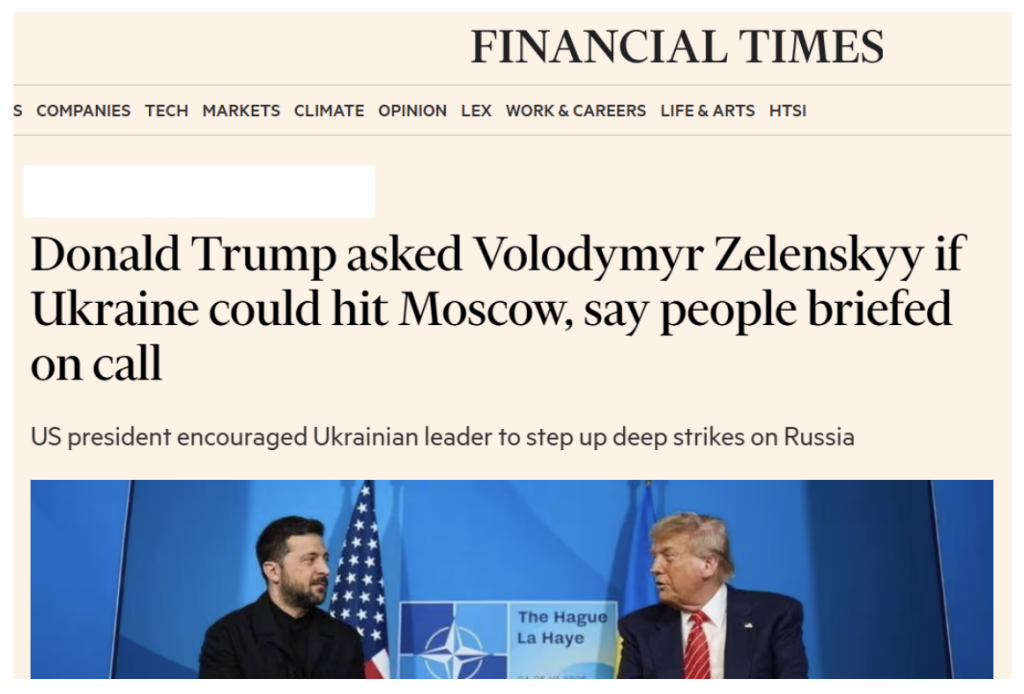
During a phone call with Ukrainian President Volodymyr Zelensky on July 4, Donald Trump is said to have proposed attacking Moscow with American weapons, writes Marc Vandepitte. This information comes from the influential financial newspaper Financial Times, based on multiple well-informed sources. This call for escalation runs counter to Trump’s image as a peacemaker and casts a new light on his handling of the conflict between Russia and Ukraine.
According to people familiar with the conversation, Trump explicitly asked whether Ukraine could strike Moscow and even St. Petersburg if the U.S. were to supply long-range weapons. Zelensky responded affirmatively:
“Absolutely. We can if you give us the weapons.”
Trump reportedly expressed his support for the idea. He described the strategy as a way to “make the Russians feel the pain” and thus force the Kremlin to the negotiating table.
This exchange is all the more remarkable since Trump had promised during his campaign to “bring peace” and quickly end the war in Ukraine. He even claimed he could do it “in one day.”
Weapons and Sanctions
After the conversation, Zelensky received a list in Rome of potential long-range weapons that could be supplied through European allies. This arrangement would allow Trump to bypass Congress. Officially, the U.S. still opposes direct weapons deliveries that might be seen as an escalation.
The list included, among others, the Tomahawk cruise missile, with a range of 1,600 km, which would enable Ukraine to easily hit Moscow. The use of ATACMS missiles (with a range of 300 km) was also discussed, though these cannot reach Moscow.
The phone calls with Zelensky came after Trump had a “bad” conversation with Putin the day before. The U.S. president openly expressed his frustration over the lack of progress in peace negotiations. He even issued an ultimatum: if no deal was reached within fifty days, sanctions and 100 percent import tariffs against Russia would follow.
At the same time, Trump stated to journalists that Ukraine “should not target Moscow” and that the U.S. is “not planning to supply long-range weapons.” These public declarations now appear mostly aimed at maintaining a diplomatic appearance.
Russia’s Stance
On the Russian side, the Kremlin remains conspicuously silent for now. Former president and Putin ally Dmitry Medvedev called Trump’s threats “theatrical” and claimed that Moscow “doesn’t care.”
Nevertheless, Russia has adjusted its military stance. After earlier Ukrainian attacks with ATACMS missiles on Russian territory, Russia tested a new medium-range missile and adjusted its nuclear doctrine.
This new doctrine lowers the threshold for the use of nuclear weapons. Russia does not rule out responding to attacks with NATO weapons on its territory with a first nuclear strike against NATO members such as the U.S., the UK, and France.
Within Russia, there are different factions. Putin currently represents a more moderate and cautious approach. However, the delivery of long-range missiles to Ukraine might provoke a harder line from the Kremlin.
Dangerous Escalation
Trump presented himself in his election campaign as the man of peace, who would end military conflicts. But this new leak from the Financial Times shows the opposite: he encourages Ukraine to escalate heavily, even toward attacks on Moscow.
If these plans become reality, we will enter an extremely dangerous phase of the war. An attack on Moscow with U.S. weapons, even if delivered indirectly, could provoke a Russian counterattack on European NATO members, potentially triggering a world war and nuclear conflict.
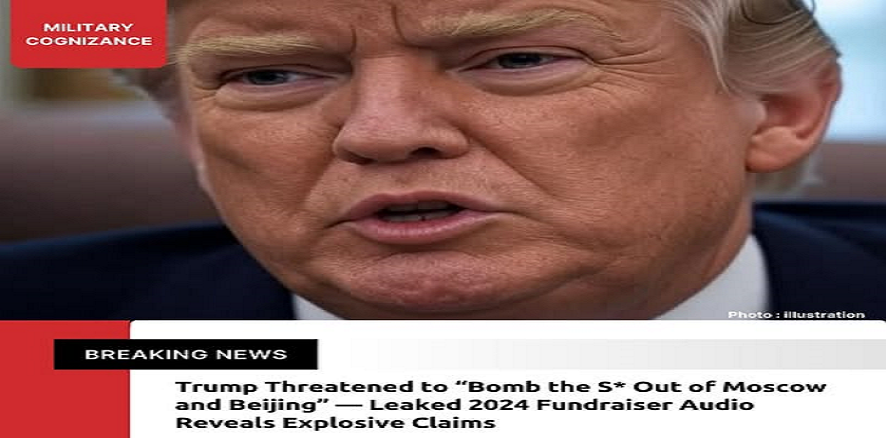
Trump Pledges to “Bomb the S*** Out of Moscow And Beijing” – G. Calder
A recording has surfaced in which Donald Trump says he threatened Russia and China with military action. The audio, which apparently captures Trump telling donors that he warned major world leaders of consequences they would face if crossing geopolitical lines, is now circulating worldwide. Amidst speculation about its authenticity, it’s impossible to ignore the public and diplomatic ramifications of such a recording. Is it just another excerpt of Trump’s usual bravado – or the brewing of further global conflict?
What Trump Said
Published by CNN, and cited in an upcoming publication by Washington Post journalists, Trump can be heard making explicit threats:
With Putin I said “if you go into Ukraine, I’m going to bomb the s*** out of Moscow. I’m telling you I have no choice”. So he goes like “I don’t believe you”. He said “no way” and I said “way”. He believed me 10%. I told you this, he believed me 10%.
Then I’m with President Xi of China. I said the same thing to them, I said you know “if you go into Taiwan, I’m gonna bomb the s*** out of Beijing”. He thought I was crazy, he said “Beijing?! You’re gonna bomb –“. I said “I have no choice. I got to bomb you”. He didn’t believe me either, he said 10%. And 10% is all you need. In fact 5% would have been ok too.
The full recording can be heard here: CNN
These comments were made during a private event in 2024 to a room of campaign donors – and were seemingly not intended to be official diplomatic remarks. So, while this is not a Presidential guarantee of future conflict, it may be a window into the mind of the world’s most powerful man.
Is It Real?
The existence of the recording has been confirmed by CNN, and the journalists who acquired it claim it has been vetted and later verified. Despite the obvious questions about AI enhancement, it appears genuine to the press. But the Kremlin is not so sure, with spokesperson Dmitry Peskov telling reporters it’s “unclear whether the report is fake“, and China has not commented on it publicly.
If real, the quotes would constitute some of the most aggressive, direct foreign policy threats ever made by a U.S. President – even in private. Considering that these claims were allegedly made to political donors, rather than foreign leaders or military officials, another layer of controversy is added.
Recklessness or Doctrine?
Throughout Trump’s political career, he has always embraced a strategy of unpredictability. Some would say that these threatening remarks reinforce what is becoming known as Trump’s deterrence doctrine — stark, dramatic, and sometimes theatrical:
- Supporters argue that the recorded comments show strength, and deter further conflict
- Critics say they are reckless, undiplomatic, and risk unnecessary escalation with foreign leaders
Whether insights into genuine policy, or simply off-the-cuff rhetoric secretly captured in an otherwise private event, the statements have now spread worldwide.
Strategic Risk & Rising Instability
The leak comes at a fragile geopolitical moment. Alongside the U.S.’s recent involvement in Israel, Iran, and beyond, we must remember that there are other situations afoot:
- The Russia-Ukraine war continues with no apparent resolution in sight
- China’s pressure on Taiwan keeps increasing, having already drawn sharp warnings from U.S. defence officials
Although no direct responses from Beijing or Moscow have been issued, these recent revelations – and how they could be interpreted by various powers – may yet fuel suspicion or strategic posturing
Echoes from Past Presidents: Nixon, Reagan, and the Art of the Threat
Trump’s trademark approach is not new. He is critiqued today for what some believe is an attitude never seen before in positions of power, but a couple of decades ago we saw similar behaviour:
In 1984, Reagan joked that the U.S. “would begin bombing Russia in five minutes” in an off-mic comment that was later leaked. The Soviet Union called the statement “unprecedentedly hostile”, evidence of the United States’ insincerity at trying to improve the two countries’ relationship, and as abuse of the office of the president.
Nixon pursued a “madman strategy”, aiming to make adversaries believe he was irrational enough to use nuclear weapons, thereby deterring leaders of hostile nations from provoking the United States. The idea was to create a psychological advantage in international relations, as opponents would be more cautious in their dealings with a leader perceived as unstable. However, its effectiveness has been debated, with critics arguing that it actually heightened tensions and led to unintended consequences, undermining diplomatic efforts. Although it may have had some success in influencing Soviet perceptions, it did not help in Vietnam, and may have instead ensured that North Vietnam remained resolute in response to Nixon’s threats.
Final Thought
Whether Trump’s words were posturing or policy, the implications may yet have serious consequences. As we’ve seen in past Presidential examples, there are different ways that comments like these can be interpreted and acted upon. However, in today’s age of perception driving action, it’s possible that statements as bold as these could escalate the very threats they aim to deter.